Showing posts with label Dennis Hamley. Show all posts

Monday, 23 May 2016

The Frankenstein Inheritance by Simon Cheshire, reviewed by Dennis Hamley

Product DetailsI really am an utter plonker. I wrote this review in May, 2014. I've just been scrolling through the Eclectic Electric archives and found it here still in draft. How could I have forgotten to press 'publish'? Well, as I hope I make clear below, this review is of a book I admire greatly and I'm really quite upset that this review didn't appear, entirely through my own carelessness. When I say 'kept in our minds' in the next paragraph I mean what I say, because it's a book which should last and last. So here is the review at last, exactly three years after the day that it should have appeared.

A few weeks ago (plus two years), Mari Biella blogged on Authors Electric asking for examples of new 'gothic' novels and Chris Longmuir suggested The Frankenstein Inheritance as the sort of book she was looking for. The reference reminded me of that terrific story and how I had reviewed it last year ( or four years ago!)  for Cally Phillips's Independent Ebook Review. Well, I think that Simon Cheshire's remarkable gothic fantasy should be kept in our minds for the super book it is, so I'm recycling and rewriting that original review, hoping it may jog people's memories and lead them to a brilliant reading experience, especially considering that when I looked at the book's Amazon page I saw its truly horrific best-seller ranking.


It is 1879. Professor Marchbanks arrives at Charing Cross station having just travelled from Europe. He is very afraid.  He is accompanied by two children, incongruously named Victoria and Albert.   There is something strange about them.  They have pale, waxy, unnatural-seeming skin, piercing, needle-sharp eyes, strange fissures and what looks like stitching on their heads and necks. They are alarmingly intelligent but remember nothing which happened more than a few days before.  They are also extremely strong: Albert even rescues some children from drowning with extraordinary presence of mind and daring within a few minutes of leaving the train.               

Yes, Victor Frankenstein’s spirit has passed on to his descendants and they are carrying on the good work.  In this parallel universe, they have bought up every extant copy of Mary Shelley’s unfortunate account and had them burnt. Professor Marchbanks has been called out to the Frankenstein castle, remote and terrifying, to give advice about the latest developments in the programme.  He is appalled by what he sees and escapes with the two children.  But their creator Wolfgang von Frankenstein is determined to have them back.

Thus starts a gothic thriller, full of the special darkness which only Victorian London can give, involving horror, some particularly nasty deaths, a chase across the stews and teeming streets of the East End as it once was – Jack the Ripper country.  The pace is breakneck, the tension taut like a bowstring.  A terrific read in its own right.  I devoured it at a sitting.

But there’s more.  Underneath its pastiche (though I don’t like using that word because it seems to cheapen the whole) is a serious debate.  Simon Cheshire is well aware of the literary tradition, the way the central image of Mary Shelley’s novel galvanised a whole genre as well as raising just about the most serious possibility which could ever face the human race.

Many writers and, of course, film directors have revelled in the story’s horror and sensationalism (after all, it  took the gothic and romantic to a new level) and are oblivious to its ethical and societal implications.  Cheshire understands how a later generation could realise what power Victor’s discovery might lead to in an industrial, capitalist society.  Technology and money meet in an unholy alliance which adumbrates the modern age: Wolfgang’s ambitions, which forecast contemporary debates about the ethics of medicine in prolonging and even perfecting life, are suddenly given shape by his realisation of the power of money and the tentacles of Victorian finance.  They have emerged from Romantic fantasy, entered the real world and become inestimably more dangerous.

Simon Cheshire has made his writing reputation through humour.  But there’s not much to laugh about here.  Nevertheless, cheerfulness does keep breaking through.  The climax of the novel, Wolfgang’s demonstration of his discovery to the most select members of Victorian society, takes place on the premises of a rather shady pharmaceutical firm on the brink of bankruptcy and desperate for the one blinding transformative success - Phage and Blight Ltd.  Cheshire has a Dickensian talent for surnames.  These, especially the second, help to suggest that, though the consequences of this occasion are horrific and serious, it is shot through with a thread of black humour.

Perhaps, however, the most impressive feature of the novel is the very one over which Mary Shelley agonised most.  What can the place of Victoria and Albert be in human society?  In Cheshire’s story, they perform wonders.  They are fiercely loyal, especially to Professor Marchbanks. They have special and entirely benign powers. They are instrumental in destroying their maker. It would be easy for them to die in the attempt: we could feel sad for a while and then erase the implications from our minds. But Cheshire's solution is far more subtle. It involves a character with another Dickensian name: Inspector Goodley, who shares with Wilkie Collins’s Sergeant Cuff the distinction of being one of the few policemen in the fictional Victorian world who is both intelligent and a force for good.  Once again, the implications of a moral difficulty are not shirked.

So – a page-turner which can be read as merely terrific entertainment and also a narrative which deals seriously with issues still current today. But there’s more. Earlier, I used the word ‘pastiche.’ Well, it is: an imitation, a modern presentation of the language and conventions of a particular sort of nineteenth-century literature.

However, to work at all, pastiche must be done well. Writing it successfully demands a deep literary understanding.  Just to check my instincts about this book, I reread the opening pages of, next to Mary Shelley, the other great peak of nineteenth century gothic writing, Bram Stoker’s Dracula, that bewildering mixture of genius and prejudice.  Jonathan Harker’s account of his journey to and escape from Dracula’s castle, with its peculiar first-person tension between paranoid dread and detached exactitude of observation, is echoed with great force in Professor Marchbanks’s opening account. And more: Stoker’s novel is a complex construction of multiple viewpoints: diaries, letters, articles, newspaper reports, reminiscent accounts, all maintaining the hectic pace without sacrificing his eye for detail.  Cheshire’s method, though on a much smaller scale, is very similar and has the same effect.

So the Victorian horror/crime/supernatural novel lives on.  The Quickening and Pietra, both by Mari Biella,  are good examples, as are Susan Hill’s ghost stories, Eleanor Updale’s Montmorency novels and Philip Pullman’s Sally Lockhart series. These are all very fine writers; in their hands, pastiche is more than imitation, more even than homage. It’s a living tradition with a lot more mileage left in it.  The Frankenstein Inheritance is a great addition to a genre which won't die quietly.

The Frankenstein Inheritance is available on Kindle and also as a paperback published independently by Simon Cheshire:  ISBN 978 095650495            


Saturday, 23 April 2016

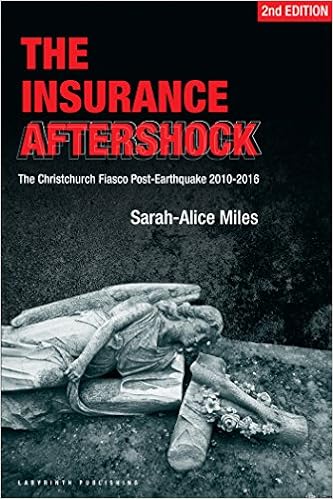
The Insurance Aftershock by Sarah-Alice Miles, reviewed by Dennis Hamley

Some of you may remember that I've often, after our annual return from New Zealand, blogged about the aftermath of the Christchurch earthquakes of 2010 and 2011. Those blogs have not merely been about personal experience. This has been, for five long years with little sign of an end, a blight on a whole community and a shocking example of the results of corporate power when governments, whether from weakness, incompetence or actual collusion - or an unholy mixture of all three - give those corporations free reign.


The Christchurch  earthquake fiasco is far from being merely of local interest. It’s a disaster which contains serious implications for us all. Relative to the rest of the world it may seem an unimportant affair concerning a small city of 300,000 inhabitants and a few in the sparsely populated Canterbury Plain which abuts its boundaries.. In fact, it is a perfect microcosm of what all countries within the capitalist system as it is organised at the moment, with behemoth private corporations being responsible for solving human and societal concerns, can expect to experience when, as is increasingly likely, they suffer major environmental disasters. For that reason, the Christchurch and Canterbury experience demands close study by both governments and the governed throughout the world. It is also why TTIP, the proposed trade pact between  the EU and the USA, should be opposed at every step, because corporations will be able to sue governments in off-shore courts outside national jurisdiction for actions which they see as harming their interests - in which case we've got no chance. TTIP is still not law, so make your voices heard in the swelling protest movement. Sadly, I'm not aware of any opposition political party in Britain which has spoken out against it. In fact, nobody at the top seems to mention it at all. Dereliction? Perhaps they are all in it together.


I speak as an observer, not a participant. However, though I am British, my wife is a New Zealander who has earthquake-damaged property in Christchurch and an insurance claim which is still not settled after five years. This means I have watched this tortuous process at close hand and been appalled by the distress, strain, anger, doubt and grief which scores of thousands of Cantabrians have suffered as they struggle for satisfactory solutions, only to find they are cheated out of their rights and the protection for which they paid, in good faith, their insurance policy premiums.

In her two books, The Christchurch Fiasco and now The Insurance Aftershock, Sarah Miles dissects these processes with a forensic scalpel. She exposes the inescapable fault-line in corporate structure. When there is a matter of public concern, where should the corporations’ first duty lie, to the clients or to the shareholders? She demonstrates clearly that corporations have chosen the second course, and also that Government has allowed this to happen. Thus, the insurance companies have reneged on what we innocently thought was the whole reason for their being.

The Christchurch Fiasco chronicles the earlier period in the rebuilding process. The Insurance Aftershock takes this further and mercilessly exposes the faults and weaknesses – yes, and concealment, incompetence and corruption - inherent in the process, ending with devastating conclusions which the rest of the world would do well to take notice of and ask whether it could happen to them.

Well, the answer is clear. Unless we, as citizens of relatively affluent Western societies, change the way we do things, yes it can. And Sarah Miles’s brilliant books, written with the same page-turning clarity and passion of writers like Naomi Klein, give a clear blueprint for what these changes need to be.

This is not a political book. It is a survey of a flawed system in operation and, inevitably, some elements refer to positions on the political spectrum. However, surely all persons of goodwill must say as they read it, ‘Things have to be better than this.’

A sinister footnote. We bought the first book, The Christchurch Fiasco, quite by accident, never having heard about it before. There were a few copies lurking on a shelf fronted by glossy guide books in the city tourist centre. There's good reason to believe that the book was actually suppressed from above. I tried to buy more copies in several Christchurch bookshops but it never seemed to be in stock. I wrote a letter to the Christchurch Press about what seemed to me to be a strange situation, that a book highly relevant to an urgent situation seemed almost unobtainable. I was told by several people that they wouldn't publish my letter. And that was dead right - I did not trouble the correspondence columns. Then the original publisher of Fiasco declined to publish The Insurance Aftershock, which is why it only exists at the moment as an ebook. I was amazed by the number of people who didn't know about the first book - including a friend, a retired senior librarian from the Christchurch Central Library, who you would expect to be aware of what went on.

I'll say nothing about arm-twisting, but such occurrences do give pause for thought. Democracy is a fragile plant at the best of times.

You can find more about Sarah Miles, her regular blogs and the many searing comments she receives  from angry people at:              
          https://thechristchurchfiasco.wordpress.com/archives/

The Insurance Aftershock is available as an ebook on Kindle and other platforms.

https://www.amazon.co.uk/Insurance-Aftershock-Christchurch-Post-Earthquake-2010-2016-ebook/dp/B01CDNK3GW/ref=sr_1_1?s=digital-text&ie=UTF8&qid=1461096757&sr=1-1&keywords=the+insurance+aftershock+by+sarah-alice+miles


k/http://www.amazon.com/The-Insurance-Aftershock-Christchurch-Post-Earthquake-ebook product

Friday, 25 September 2015

The Amazon's Girdle by Elizabeth Mapstone reviewed by Dennis Hamley

Elizabeth Mapstone can point to many achievements. She translated Moliere for the Canadian Broadcasting Corporation. As a psychologist, she was a Founding Editor of The Psychologist and  wrote Rational Men and Disagreeable Women: the social psychology of Argument, published by Vintage, and War of Words: men and women arguing, published by Vermilion.

Product Details

When a writer already eminent in other fields produces a first novel there's always just a nudge of fear that the talent is not transferable, that the book may fail, that it is a a bridge too far. In Elizabeth Mapstone's case it certainly hasn't been. This is an absorbing, many layered story, beautifully written, which holds the reader's attention through out and keeps the mind active even when the book is finally closed. The structure is complex yet always clear. It is a novel of two, even three, time scales and told from a multitude of different points of view. but the reader never loses track. To keep hold of such a subtle plot and not allow it to fall into chaos is a high novelistic skill.

An ageing film start intends to visit a Paris restaurant owned by her parents. Charlotte's parents react oddly. Her mother is furious. If Madeline Marvell, Queen of French Cinema, comes, she will go, she threatens. Why? Her father, Jacques Corot, was a film star himself once and Charlotte realises she knows nothing about her parents' past lives. Here is a mystery. Who is the Amazon? Why did Charlotte, in Paris on holiday from her English boarding school, never know she was adopted? So many questions. 


So Charlotte determines to find a solution. She finds out the Amazon's identity and just how central she was to her own life. She uncovers a tale of love, jealousy, betrayal and in the end a revelation truly shocking. The story has a wide panorama of time and place. It visits French cinema of the 50s, London, a village in Cornwall where lives a retired and disabled doctor with much to say, World War 2 and the French Resistance. And gradually Charlotte works out for herself an intriguing and appalling truth which leads to the solution of her life's mystery.

For me, the best sort of narrative is the one when we can have two reactions as we close the book which seem mutually exclusive - the ending was a complete surprise: the ending was inevitable - and mean them both equally. That is exactly what I felt when I finished The Amazon's Girdle and that is why I found it so satisfying. And it is beautifully written too.

The Amazon's Girdle is published both as a paperback and an ebook.

Sunday, 16 August 2015

Black Waters by Julia Jones, reviewed by Dennis Hamley

This is the fifth novel in the Strong Winds sequence and is a tough book dealing with tough – and urgent – questions.   Here, the emphasis is on Xanthe, whose prototype is Arthur Ransome’s Nancy Blackett.  Black, vulnerable yet superbly strong and resourceful, she is the outsider in this story, which could easily be subtitled ‘Xanthe Alone.’ For there is much ranged against her.  


Julia Jones has a genius for portraying evil, which she's already shown in the Strong Winds sequence from The Salt-Stained Book onwards. Here, the contagion  starts during the Olympic yachting trials, where Xanthe’s main rival is the beautiful, rich, ominously-named Madrigal  Shryke. I was creased up with anger at Madrigal. I could hear her speak: I could recognise her particular brand of vitriolic nastiness and utter vindictiveness.  One of the many virtues of this novel is the satisfyingly unexpected nature of her eventual destiny, which suggests surface nastiness comes with deep-rooted character defects.

And this capacity for evil is not confined to Madrigal's devilish articulacy. It spreads into society generally: the Essex coast and the corporate future it seems destined for become a metaphor for our whole society.  It alarmingly raises a central  problem. As Jan Needle asked in a recent blog, are the very rich intentionally criminal? Is the corporate ideal  incompatible with any democratic version of the good life?  Julia Jones’s dramatisation of this mentality in the microcosm of the Essex Blackwater suggests that it is and its far-reaching consequences are now unambiguous. But this is also a superb mystery story. Xanthe, as a way of trying to blunt the misery of her experience at the hands of Madrigal at the Olympic sailing trials, becomes a sailing instructor for disadvantaged children. In doing so she unlocks a family feud which has gone on for generations and conceals  a pure evil of which Madrigal’s nastiness is just a symptom.

Behind all the Strong Winds novels is the inspiration of Arthur Ransome. Many writers, including me, will tell of his influence - how he almost taught us how  to write. But surely his are out-of-date books based solely on sailing and camping? There was no call in what we mistakenly see as his settled, unquestioning world for the moral indignation which is such a feature of Julia Jones's work. After all, the nearest to villains in the Swallows and Amazons series, apart from the incompetent buffoons who steal Captain Flint's precious manuscript, are surely the Hullabaloos in Coot Club and they are only noisy, vulgar and drive their motor launch too carelessly round the Norfolk Broads. Not so. Ransome just once gives vent to  real, deep-felt anger in the way which is reflected so much more all-pervadingly in Strong Winds generally and Black Waters in particular. It's in Great Northern? where Dick Callum, elated at having evidence that the Great Northern Diver really does nest in the British Isles, rows across to tell Mr Jemmerling, the great naturalist, about it. And there he finds that Jemmerling is not what he seems. He is an egg collector. His proposal to prove Dick's discovery to the world is to steal the eggs and have the birds shot before witnesses, stuffed and put on display.

Dick escapes in tears and the novel's central theme, leading to a deliciously satisfactory ending, is thus assured. This to me is one of the great scenes in children's literature. Its power angered me when I was eleven and that indignation is still with me when I reread it now. It dramatises Ransome's revulsion at the deliberate perversion of the moral order Mr Jemmerling presents. A small example perhaps, but Mr Jemmerling in his self-centred greed is himself a corporation in miniature and as symptomatic of the mess we've got the world into as the more far-reaching concerns of Julia Jones in this extraordinary sequence of novels. And it indicates what a worthy successor she is to that wonderful author.

Julia Jones shares and carries on Ransome's wonderful knowledge and experience of sailing, which always leaves me in a state of admiration spiced by a comfortable sort of ignorance. Like Ransome, she is not afraid to put her characters in situations of extreme danger at sea which can be countered only by exceptional expertise. Here, in a climactic scene, we have Xanthe truly alone, and her sailing competence not only proves the point she would have made at the start were it not for Madrigal but contains taut and dramatic writing of a high order. Potential readers who don't know what to expect in this matter can get a taste of it in Julia's short story in Flash in the Pen, the anthology from Authors Electric, now on Kindle as well as in paperback.

Black Waters is available on Kindle and in paperback, published by Golden Duck.

Monday, 6 July 2015

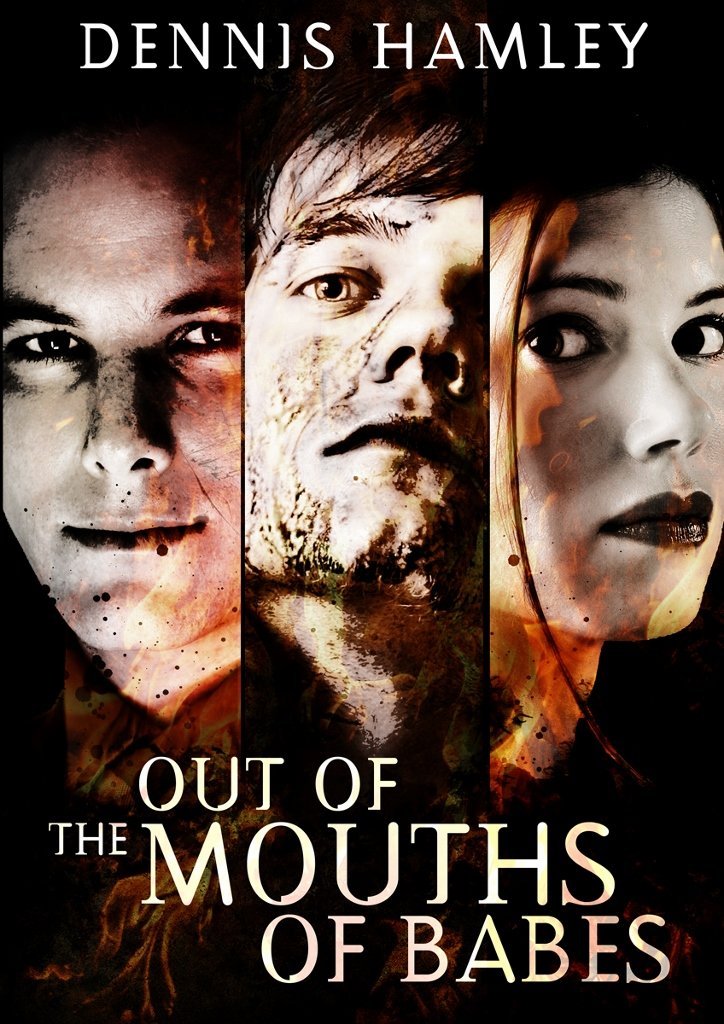
Out of the Mouths of Babes by Dennis Hamley - reviewed by John A. A. Logan


The lives of this novel’s three protagonists, Gary, Julian, and Grizelda, are interwoven beautifully from the outset, with the shifts from one character’s life and world to the next creating a sense of great momentum in the narrative.
I would characterise the voice of this book as one of warm, and sometimes grave,  sensitivity, which suits the psychological depths the story must plumb, particularly in the cases of Gary and Julian. One skill which the author brings to the storytelling here is an almost unique, it seems to me, ability to shift backwards and forwards through time, but without ever losing or confusing the reader. This makes for an endlessly interesting, kaleidoscopic helter-skelter ride through the inner sanctums of the characters’ subconscious impulses, setbacks, growth, development – and finally sets the scene for a penetrative meditation on the theme of guilt itself. How responsible is an individual for the lives and deaths of those they come in contact with? Where is the “line” which defines the beginning and end of such fine levels of responsibility?

This is also the story of the working class/underclass, versus the middle/upper middle class, versus the upper/ruling class of the sort of class-ridden British society which, of course, once moved George Bernard Shaw to comment: “It is impossible for an Englishman to open his mouth without making some other Englishman hate or despise him.”
In Hamley’s novel, though, it is the souls of these Englishmen, and an Englishwoman, which are opened before us, bared to us and also to each other. Though perhaps Grizelda’s soul is not quite so laid bare: rather she is the witness and commentator, even the mediator, attempting to bring justice, perhaps healing, to her lover and to her lover’s childhood victim, Gary.
Gary has been through the fires and the furnace, much of him that would have flourished in more providential soil has been seared and singed away by brutal experience, and injustice. He has emerged on the other side, though, reforged himself into a new form, and it is the destiny of this new form, or new self, that this novel will gradually unfold.
Julian, on the other hand, has been brought up and trained since birth to rule “this sceptered isle”, it is assumed to be his right, his destiny. If the talents of another, or the fruits of those talents, must be appropriated through deceit in order for Julian’s path to be better cleared towards greatness, then that is work worth doing (and Julian will find willing accomplices in that work). And, of course, the results of all that work cannot be “wrong”, they must instead be viewed as expedient method, for the furthering of that Great Destiny which Providence surely must have intended always. Though, if Julian himself is only a child, brainwashed and trained, when the deceits begin, how deep does his personal responsibility really lie? And there begins Mr Hamley’s meditation and penetration on those deep themes of true responsibility and guilt.
Grizelda’s own experience allows her to straddle both worlds, Gary’s and Julian’s, and see the potential in both men, though she is perhaps not conscious yet that her own brilliance has also been co-opted and assimilated into the fulfilment of that destiny for Julian, which Gary’s early incandescence was also absorbed into, as though by the greediest and hungriest of Black Holes.

The supernova potential of this world’s Garys and Grizeldas, only to be thwarted then, devoured, leaving nothing but stellar clue remnants in the black corners of space? Or can such tragedy sometimes result in even stranger fruit?
Julian Claverhouse has his cosmic destiny after all, by right of birth and upbringing, to rule the land - no Oik from a Council estate is he – but equally, when so much of the material absorbed into a Black Hole has come from the best, blazing potential of others, how much of that Black Hole can still be said to consist of the “right Claverhouse stuff” by Journey’s End? Perhaps even one toenail-clipping of Oik in the powerful final mixture could be enough to spoil the alchemy, or perhaps otherwise, enough to save and justify its existence at all?
Julian Claverhouse may very well end up in the exact spot everyone has always been aiming at for him, but by the time he gets there will he still really be Julian Claverhouse? Or, like Cronenbergian fly DNA in his soul, will he carry little pieces of Gary and Grizelda with him always, wherever he may go?
Perhaps Hamley’s message is that all those pulsing stars up there, visible  in the black sky, are really the result of the crashing together of countless disparate fragments, the mangling together of many destinies, to make that strange cosmic fruit cocktail which often may be more the consequence of accident and dream, than breeding.
Gary’s social background, after all – Assessment Centre, Special School, homelessness – is not often the stuff of literature (which, unfortunately, goes a long way to prove Hamley’s point here), but the Gary of this novel is destined to be, at least, the thorn in the British Lion’s paw; and what may come of that is the engine for this story, fuelling its journey into the unknown and unknowable, as, by Black Starlight flooding through the portal window on our right, we make the next mind-bending turn, before shooting onwards, towards areas of social, spiritual and psychological Deep Space we cannot yet see perhaps, but we sense are out there nonetheless.


Tuesday, 25 November 2014

Edge of Dreams by Debbie Bennett, reviewed by Dennis Hamley

This review first appeared in Independent Ebook Review in 2011. It seemed to me that Edge of Dreams is a book which has not had the recognition it deserves. It has power, tension, the compulsion to turn the next page over, all the properties of a cracking read wrapped up in a disturbing fantasy which has real-life echoes.

Product Details


Straight away, the beginning demands our attention.  Calith, with his black, white and orange hair, is being warned off.     An older man, quiet, forbidding, with an underlying menace, whose name is Vayan, wants him to keep away from someone called Ricky.  Calith can observe him but no more, even though Ricky has an instinct for the ‘power’, an as yet undefined but none the less perilous quality. Vayan's command has an ominous bite to it. Calith knows his future progress is fraught with real danger even though he does not know where this danger will come from..
And then, back in our own world, we met Ricky.  Though he is at college, he is nearly beyond the law.  He is a joy-rider and one night sees a woman leaving her Ford Fiesta unlocked, steals it and is chased by the police.  But just as he is about to be caught, he is suddenly snatched into another dimension.  He recognises it as the world of the dreams which have been haunting him. Calith was in these dreams – now he is inside his head and soon he meets him in reality. So begins a strange and  original fantasy.  Debbie Bennett warns – or assures - us that there are no trolls, dragons or any of the usual trappings of fantasy. And she is right. The story doesn't need them. It is entirely to do with human relationships carried to an extreme of intensity.  The ‘power’ is to do with dreams and being able to enter them and make them real, both their own and other people’s, to control those people, to – at the extreme – steal their personalities.
Calith comes from a parallel world powered by these dreams.  In that world, he lives in Kelrinna, led by Vayan.  There is another place, Venn, the master of which is Saxen.  Saxen is pale, fair-haired, almost albino.  Vayan is dark with a moustache.  The light and the dark, opposite poles.  The novel is in effect a struggle between them for Calith’s soul.  Ricky’s function is almost that of the reader in the book.  Because of his humanity he gives a sort of authenticity to this strange world of telepathy, control, seals which are strong yet can be broken: he has the powers and he learns to use them – at the end triumphantly.  But, despite their unearthly qualities, the other characters are all too human as well.  Their powers are used for mastery, treachery, subterfuge – and also loyalty.   The struggles are carried out with strange, internal weapons.  There are ambiguities.  Who are we to believe: Saxen or Vayan?  Both are plausible.    What are Karsh,  Shanna, Teris and the others; friends or foes?  How can Louise, Ricky’s sister who is suddenly, through Calith, thrust unknowingly into this strange place, be rescued?
The characters hold conviction.  Calith, puzzled, torn, slightly out of control, is memorable in his complexity, as is Ricky in his developing understanding and Louise in her mystification at where her attraction to Calith has led her.  Vayan and Saxen have themselves an ambiguity which means we are never on safe ground in the story – but in the end we know which is the one worthy of trust.  And we find out in a tremendous climax.
A remarkable book.  It absorbed me, carried me through a kaleidoscope of impressions and at the end satisfied me deeply.

Edge of Dreams is available on Kindle. I would like to see it in paperback as well.


Monday, 6 October 2014

Celeste by Ann Evans, reviewed by Dennis Hamley

Megan Miller is devastated at leaving her home in South Shields and moving to Coventry. She has never been to Coventry in her life, as far as she knows, but she immediately feels that some things are very familiar to her, three church towers dominating the city, for example. Disoriented, she starts at her new school - and meets Freya, who has a curious resemblance to someone she knows very well yet has no recollection of meeting. And then there's Jamie Monkman, attractive and  interesting in other ways besides his good looks and the elaborate pattern cut into his hair. Freya laughingly tells Megan that Jamie thinks he's been on earth before and can remember being a a Viking, a monk, a Tudor weaver. But Megan does not laugh. And she's not laughing when she goes to the bombed-out ruin of the old Cathedral and has an overpowering feeling of fear and terror separate from the desolation of the miraculously still-standing remnants of a once beautiful building.

Celeste

Time-slip novels are very hard to get right. They are not arbitrary transferences just to set a story going. Even at their best, they need a willing suspension of disbelief, more so than in most other narrative forms, and they need a lot more than science-fiction machinery to be in any way convincing. First, the subject must be psychologically and emotionally vulnerable and therefore open to unexpected phenomena. Second, the subject must have a deep connection with the time into which she or he is to slip into, even if the connection is unconscious. And third and most important, the writing must be of such high quality as to take readers on a strange journey without protest, too involved with the power, persuasiveness and closeness to real human experience of the narrative, never questioning its reality and validity.

Celeste passes all these tests. Ann Evans's prose has clarity and tautness and transmits a wide range of feeling. I'm not going to give spoilers to the complex story which develops, except to say that it involves strange memories of previous lives - a sort of reincarnation - which eventually bring Megan not just to a sojourn in a long-ago age  but a disturbing confusion between two existences which seem to be happening almost simultaneously, bringing a genuine terror not just to her but to the reader. She is a major player in a medieval story deeply embedded into the history of Coventry, at the centre of which is a power object which may or may not have the special powers given to it by long-ago people but which must be kept out of the wrong hands in case it does. And Megan has the appalling suspicion that this story has reached out from eight hundred years into the present and is still continuing - and that the identity of her ancient scourge might involve someone close to her in the present day whom she trusts and likes.

The novel reaches a truly gripping climax and I closed the book feeling that I had read something which had touched me at several levels. It's intended for young adults and the cover, title and most of the main characters seem to point to it as being mainly for girls. But it isn't. Anybody, male or female, old or young, who likes history, the supernatural and fantasy based securely in recognisable, tangible and believable settings will love this. I did.

Celeste is available in paperback, published by Astraea Press. It is also available on Kindle
http://www.amazon.co.uk/Celeste-Ann-Evans-ebook/dp/

Sunday, 28 September 2014

Divided Loyalties by Dennis Hamley

Reviewed by Chris Longmuir

It was only after I’d read several chapters of Divided Loyalties that I realised it was a continuation of Ellen’s People which I recently reviewed for Eclectic Electric.

Ellen’s People: Without Warning, was a book set during the First World War, and it told Ellen’s story from her point of view. This second book, which I understand is part of a trilogy, is set prior to, and during the Second World War. So, a lot of time has passed since the end of the first book.

Divided Loyalties differs in style from Ellen’s People because it is a multi-viewpoint novel. Instead of being Ellen’s story, it is the story of Ellen’s family, and it begins with chapters featuring Ellen’s sons, which was why I hadn’t made the connection with Ellen’s People at an earlier stage.

At the beginning of the story Ellen has been married to her German husband, Matthias Vogler, for nineteen years, and they have three of a family, Walter who is sixteen at the start of the book, Paul who is eleven, and Anna who is eight.

Walter, the elder son, is not a likeable character and he is deeply resentful of his germanic roots which makes him hate his father. Nevertheless, of the three children he is by far the strongest character and I was drawn into his story and became deeply interested in what happened to him. Paul and Anna were more likeable, and their characters were less conflicting, therefore less addictive for the reader. Ellen, was once again, finely drawn, and her problems and emotions are shared with the reader.

There were many divided loyalties in this story. Walter’s hatred of his family and his germanic origins. Ellen who is split between the two of them. Matthias, whose German relatives embrace the Nazi cause, and the emotional conflict this causes within him, because on the one hand he loves his German family, but on the other, he hates Nazism and everything it stands for, and is fiercely loyal to his adopted country. His loyalty, however, does not prevent his arrest as an enemy alien, and his internment, first in the Isle of Man and later in Canada.

As well as the emotional impact of the story, as the story progresses the reader is also taken onto the battlefields to follow Walter’s story as a rear gunner in the RAF, and the story of Helmut, his German cousin, first as a member of the Hitler Youth, then as a tank commander on the Eastern and Western Fronts. There is a sense of fear and disorganization, but also one of disillusionment in these sections.

This was a well written and absorbing novel with characters who became real people with the ability to strike up an emotional relationship with the reader. If this is the second book of a trilogy, I can’t wait to read the third.

Chris Longmuir

You can buy the ebook here


Thursday, 18 September 2014

Divided Loyalties by Dennis Hamley ... reviewed by Julia Jones

Dennis Hamley has set himself a challenging task -- republishing the first two volumes of his 'Ellen' Trilogy within a month of each other while still at work on the final part -- Unfinished Business.  Ellen's People came out in August and has been reviewed both here and on the ABBA site: Divided Loyalties appeared on schedule earlier this month (September).
   It's possibly not quite as ambitious a programme as Author's Electric Nick Green who bought out all three volumes of the Firebird Trilogy on a single day  but I would guess it still means that Dennis will have been foregoing some of the gentler pleasures of retirement. Will he be yearning for the uber-professionalism of Walker Books, the original publishers of Divided Loyalties?  Possibly, when engaged in fruitless negotiation about cover designs and managing all the nitty-gritty jobs that seem almost as demanding as writing. Certainly not when they then pulled out of publishing the concluding volume. I believe Nick Green suffered a similar let down in the final stages of a previous series.
   So here we have two authors, free to make their own choices about timing the release of their work. Neither chooses the book-a-year model of corporate publishing: one goes for broke on a single day, the other is publishing in monthly parts, making the readers wait but not asking them to wait too long. I used a six-month time scale for my 'Strong Winds' trilogy, though that was as much to suit my own circumstances as to attract / retain an audience. And still, three years on, the first volume outsells the other two by a margin that seems to replicate the worst features of primogeniture. Will Nick and Dennis find the same or will their alternative timetables even things up?
   It seemed to me that the second volume was the hardest to write -- how quickly could I move on, how much sign-posting and reiteration would be necessary? How to conclude without actually completing? I was correspondingly fascinated to see how Dennis Hamley could ensure that Divided Loyalties was not eclipsed by its successful older sister? By writing a completely different book -- both structurally and thematically. Divided Loyalties is independent from chapter one.
   When I reviewed Ellen's People  I mentioned that I was looking forward to following Ellen in her post-war future as she and her German husband, Matthias, attempted to settle back into their possibly depressed 1920s village. I think I'd expected some sort of fictional Akenfield. Not a bit of it! Hamley leaps the reader forward more than a decade and Divided Loyalties opens in 1935 with Ellen and Matthias's stroppy oldest son, Walter, blasting away at clay pigeon targets and wishing they were his equable, understanding father.
   Ellen's primary role in this novel is as the loved and loving mother: most of the fictional interest lies with the next generation. Walter is troubled, angry, confused and it's a strength of Hamley's characterization that he doesn't offer the easy reconciliation that this reader, at least, was longing for. There is also Helmut, the Nazi cousin, Paul and Anna the younger and more conventionally talented children. They've had an easier upbringing as Matthias and Ellen have prospered -- though Matthias will discover that even twenty years' blameless residence may not be enough to spare him when England and Germany go to war again.
   In my review of Ellen's People I  mentioned that it didn't tell me anything much about WW1 that I didn't already know (I hope I made it clear that this was an observation not a criticism -- and might, anyway, only be personal). Divided Loyalties, the WW2 novel, has taken me onto less familiar ground -- such as the forced evacuation of internees to Canada. I enjoyed being RAF ground crew, then a rear-gunner with Walter and a tank commander in the Russian campaign with Helmut. This is a novel with strong male characters and Hamley portrays their lives on active service with authority.
   Plot-wise it's a pleasure to have known Ellen in her younger days and there are some back references to Ellen's People but it's certainly not essential.  In fact I can imagine young male readers going straight for Divided Loyalties with never a glance behind them. I wonder what the third volume will hold -- I'm certainly not going to attempt any predictions!

Divided Loyalties by Dennis Hamley was first published by Walkter Books in 2008 and has now been reissued by the Blank Page Press

Monday, 8 September 2014

After Tomorrow by Gillian Cross, reviewed by Dennis Hamley

Reading and reviewing Cally Phillips’s Brand Loyalty started me thinking afresh about dystopias. Why have there been so many of them written in recent years? Why are most of them visions of generalised horror, dark fantasies which don’t seem to have any correlative in actual reality? On the other hand, why are some - like Cally’s vision of corporate power sucking people into an existence spent in a limbo of virtual reality or Bill Kirton’s Alternative Dimension, which finds glorious humour in the situation - based on an urgent vision of the logical extension of the dangerous ugliness in our society today? Is it because we are smothered by apprehension of imminent disaster? Is WB Yeats’s The Second Coming coming true again?

Surely some revelation is at hand?
…what rough beast, its hour come round at last,
Slouches towards Bethlehem to be born?

Well perhaps it’s here already? It might take many forms: there are so many which are plausible. But here is a young adult novel which takes an ominously possible circumstance  and develops from it a narrative based on an alarming logic which we feel on our pulses to be an all too accurate estimate of human behaviour in extremity.


Product Details


The premiss on which  After Tomorrow is based  is something which could conceivably happen tomorrow. No more nuclear holocausts, no more climatic catastrophes, no more corporate corruption (though this, in the light of Brand Loyalties, might be a moot point), just a possibility - yet one which, when we wake up each morning, we might find has happened, suddenly and disastrously, overnight. This Armageddon comes when the country’s five largest banks crash at the same time. As a result, infrastructure and law and order have broken down. Armed, desperate and unscrupulous gangs roam the land for food. Their targets are those who have selfishly hoarded food or, unselfishly, are still producing it. SCADGERS is spray-painted on their houses and they are marked out as fair game. The best hope for Scadgers is to escape as refugees to France.  An uncomfortable irony, especially as France is on the brink of going the same way.

Marty tells the story. She was only four when the crash came and didn’t understand it, except when Dad was shot as he drove a lorry loaded with potatoes to Manchester. Raiders killed Grandpa on his allotment. Mum has married again. Marty has a stepfather, Justin, and now understands the situation all too well. After a gang raid which takes all their remaining food and leaves the house trashed, they know they have to leave before France closes its borders and the rest of Europe follows them.

Their neighbour Bob has a truck and is filling it with refugees before it’s too late. Mum, Justin, Marty, little Taco and all the family leave home – and find France as unwelcoming as they feared and expected. But they survive. Their struggles make a compelling narrative. Nothing is what it seems: corruption has spread even to those they trust. There is no point of rest in this new world and any prospect of amelioration seems doomed. There is a note of hope at the end, but it is a forlorn one indeed. As in Lord of the Flies. humans in extremity revert to the savagery of self-interest. Perhaps Thomas Hobbes was right about humankind after all.

This is a timely and disturbing look at a version of the future which has uncomfortable resonances. It’s told with all of Gillian’s Cross’s wonderful narrative skill. It’s good that it’s a young adult book. We hard-bitten oldsters, made cynical by experience, understand most of this. For the younger reader, even the realisation that they could so easily become refugees, just as much as those who flee from Jihad, will be a shock. After Tomorrow is full of propositions which should bring younger readers up short as they see possibilities which they should surely be aware of. 

Gillian Cross is a young adult author of long standing and huge achievement. A Carnegie Medal winner, she knows how to construct narratives which reverberate in the mind long after the book is closed.


After Tomorrow is published by OUP in paperback. It is also available on Kindle.

Saturday, 30 August 2014

Brand Loyalty by Cally Phillips, reviewed by Dennis Hamley

I wish I had a pound for every dystopia I've ever read. I may not end up rich, but I could buy a few more branded goods with the money - and therefore I'd fall straight into Cally Phillips's trap. If dystopias are formed by identifying contemporary features and extending them to their logical conclusions, then this is the ultimate dystopia because it's taking the the whole principle of what fuels our present society and extending its appalling implications to virtual infinity. Corporate totalitarianism. What a terrifying concept. And yet it's here already. 


Brand Loyalty


The TV programme broadcast in 1913, No Sex Please, We're Japanese, depicts men retreating from actual life and finding satisfaction in a virtual, contactless world - and countless others, are following the broad highway into unreality, pretty well a whole generation. The destinations may differ but the process is the same. In the vision Cally Phillips depicts, it is the norm. The ULTIMATE(R)corporation is now everyone's reality, where everything is barcoded, trademarked, copyrighted and there is no notion of individual personality or ownership. The ultimate prize is a pod which traps you for ever into unreality. Children think plastic flowers are real, history and the future have disappeared and what's left is the deadly prison of the present. Can this dreadful world be somehow repealed? Well, reality and humanity still exist,and ULTIMATE(R)cannot force the choice because the mind is its own place and has the power to come to a different conclusion. But can the few protesters ever subvert the process? Has Helen at the end reached the only remaining reality? Is the message of the final parable all we have left? 

This is an amazing, searing book. Cally Phillips's prose is springy, punchy and has utter clarity: an ideal combination for this novel. Other reviewers have wanted Brand Loyalty to be filmed or televised. I agree; it would be brilliant. But as the real(?)-life ULTIMATE(R) Corporations creep subtly over us, would anybody dare? Well, if anybody is going to, then they must speak up now. The appalling EU-US Trade Deal, negotiated in secret and soon to be ratified, will enable corporations to sue national governments if they think their interests are being harmed. And with the general pusillanimity of these governments combined with the fearsome legal resources available to the corporations, who is to say the corporations won't win hands down every time? We are entering an age in which dystopias come true. 

Brand Loyalty is available on Kindle and  in paperback


Monday, 25 August 2014

Ellen's People by Dennis Hamley

“It’s dark now. The church clock has long struck midnight. Betty and Madge, twins and my younger sisters, went to sleep the moment I blew their candle out, but I can’t sleep and I’m wondering if I ever will again.”

Thus begins Ellen’s People, the first novel in Dennis Hamley’s Ellen Trilogy. Ellen Wilkins, a young woman living in rural England on the eve of World War I, has just witnessed a recruitment drive in her village. She has also witnessed some of the less attractive behaviour associated with such campaigns: jingoism, hatred of “the Hun”, and fury against those who openly prefer peace to war. To Ellen, this is more than a purely abstract concern: her beloved brother Jack has enlisted, and she worries about what might happen to him. “I don’t know much about wars,” Ellen admits, “except soldiers and sailors get killed and Jack might get killed with them.”

Ellen’s first-person, frequently present tense narration is deceptively simple. Hamley achieves a beautiful balancing act here: Ellen is highly intelligent and insightful, and yet her tone fits that of a country girl from a simple background who has received rather a basic education. Like many girls of her class and time, any form of Further or Higher Education is out of the question for Ellen: simple economic necessity means that she must, at a young age, go out to work as a maid for a wealthy family. The appalling drudgery of such work is not glossed over; Ellen and her fellow maids work long, gruelling hours for little pay and even less gratitude. When they act together to win a small but significant victory over their employers, we’re absolutely behind them. This small act of rebellion – which is really little more than a simple demand for respect – is also an indication that the determined, courageous Ellen will not remain a housemaid for long.

In the meantime Jack returns from the trenches – alive, but missing a leg, and carrying a world of rage and distress within. As Ellen struggles to nurse him and hold her family together, she develops a strong empathy for the injured and sick, and an interest in nursing as a profession. Eventually, she goes to London to train as a nurse, and from there to join the nursing corps on the Continent. From this point on, the war – which occasionally seemed rather distant in Britain – becomes shockingly real and immediate. There are hellish depictions of the bloody reality of trench warfare. Soldiers are brought into the hospital with destroyed limbs, burns, gaping wounds in their stomachs; many die in agony in front of Ellen’s eyes. There are times when she wonders if she can carry on. She does anyway, constantly growing in empathy and insight. In the end, Ellen transcends her own limitations, the expectations imposed by her sex and class, and becomes a truly rounded, sympathetic, experienced woman.

Ellen’s People is not only about war, but about the prejudice, tribalism, and blind patriotism that give rise to warmongering. It is about much else besides: a class and social structure that was slowly being eroded, family and social relationships, and the increasing shift of power to women as they not only entered the workplace but began to take on ever more responsibility. This is, in short, a world that is becoming more recognisably like our own. 1914 and the outbreak of World War I are, obviously, a full century in the past now, but their repercussions are still being played out today. If anyone thinks that this period of history has lost its immediacy and power to shock, try reading Ellen’s People. Ellen’s urgent, insistent voice speaks directly to us, and her experiences become our experiences too.


Ellen’s People is published by the Blank Page Press. It can be purchased from Amazon.com or Amazon.co.uk.

Saturday, 16 August 2014

Ellen’s People by Dennis Hamley

Reviewed by Chris Longmuir

Ellen’s People is a book with hidden depths. On the surface it is a simple story of one girl’s perception of the life of her family in wartime Britain.

It starts with a recruitment drive for young men to join the army in the early days of the First World War, when Ellen’s brother Jack joins the army. Through Ellen’s eyes we follow the jingoistic speeches which whip up enthusiasm for the war, and her fears for her brother. There is a sense of patriotism, a call to the colours, and war fever. But this leads to mob violence reflecting hatred for ‘The Hun’ with sympathisers being given short shrift. This sets off a series of events which become quite nasty.

However, things settle down and life goes on as normal with the impression of the war being far away. Ellen’s life follows it’s usual pattern which is the norm for women at the time. She lives at home and engages in domestic duties, although there are hints that changes are afoot for women.

Ellen goes into service against the wishes of her parents and gradually starts to become more independent. It is a gradual process although, through the passage of time, she trains to be a nurse and eventually goes to Abbeville to nurse soldiers.

The effect of the war on the villagers seems negligible at first, and there is a normality to the lives of the family. It is as if the war is a far distant thing that does not impact on them, until Jack comes home with only one leg after an amputation. But, even then, the full horrors are not apparent, and this reflects the propaganda stance the government took on the Home Front, where the realities of the conflict were not shared with the populace.

Slowly the realistion of what the war is all about dawns on Ellen, although it does not really prepare her for the full horrors she will experience when she goes to Abbeville in Belgium to nurse dying and wounded servicemen.

Ellen is an engaging character with the ability to draw the reader right into her life. The normality of that life in the beginning, and the blinkered view people had to the war, contrasts with the reality of the war’s impact. The class system at the time and the powerlessness of servants is obvious, as is the gradual shift of power to women who want to work. There are many threads to this story, but none more so than Ellen’s gradual awakening to the full horrors of what war entails.

This is a book well worth reading, and one which will draw the reader in with a firm grip, and not let go until the final paragraph.

Chris Longmuir

You can buy the book here:


Monday, 4 August 2014

Ellen's People by Dennis Hamley reviewed by Julia Jones

Ellen's People is the story of a young girl and her family struggling to survive the First World War. In August 1914 Ellen is just 16 and is living in the Sussex countryside with her parents, her older brother and two younger sisters. Her father is a signalman and has some strong 'anti-toff' views. Class suspicions, village tensions and family relationships make for an unexpected flare-up of local conflict when the recruiting officer arrives and Ellen's brother volunteers. There is, as any reader will guess, considerably worse to come.

Ellen's People is suitable for older children as well as adults. The horror and the strain of war is fully acknowledged but it is mediated through the central character, who is a loving and grieving sister rather than a combatant. There is a simplicity in the writing which is attractive and accessible and reflects Ellen's youthful personality. From a relatively sheltered position in the middle of her family she is forced out into the world and has to make her own accommodations with the mix of snobbery and kindliness that she encounters from her employers and others. Dennis Hamley is adept at conveying the social attitudes of a century ago while avoiding stereotypes. One of the pleasures of Ellen's People is the variousness of the characters, whatever their class. Their reactions are determined by their personal and moral qualities as much as by the conventions of their social position – though these are never underestimated.

I found Ellen's People a pacy, engrossing and convincing read -- though as an adult with a strong interest in history it didn't tell me anything about World War 1 that I didn't already know. But that wasn't why I was reading it.  Dennis Hamley is such an accomplished writer and develops Ellen as an engaging and honest observer as well as a quietly determined participant. I'll be glad to follow her in her postwar future though I don't suppose that her life is going to be easy as she attempts to settle back into the village. In these four traumatic years Ellen has learned too much about humanity to be comfortable with narrow class-based or nationalistic assumptions -- rather as the gallant Boer War veteran of the opening chapters had found himself dangerously out of sync with his neighbours back in the sunny days of August 1914.

Ellen's People is published as an ebook on August 4th 2014 and will soon be the first production from the newly founded Blank Page Press.
In the USA Ellen's People was published as Without Warning

Thursday, 17 July 2014

Wild Wood by Jan Needle, reviewed by Dennis Hamley

The reissue of this marvellous novel must rank as a Literary Event. First published in 1981 by Andre Deutsch with unforgettably brilliant illustrations by William Rushton, Wild Wood should have been widely recognised for the classic book it undoubtedly is instead of going out of print early. Well, to some of us, it always has been a classic and its reissue, revised and even improved, after nearly forty-five years is an occasion to celebrate.


The new Golden Duck edition

It’s not a sequel to The Wind in the Willows. It’s not a retelling in any but the vaguest sense. It’s a complete re-imagining, a companion piece, almost a concordance to the original, as Tom Stoppard’s Rosencrantz and Guildenstern are Dead is to Hamlet

Product Details

Not even the original hardback, but it will still set you back £197 on Amazon Marketplace

Oh, in Wind in the Willows, how disturbed Ratty, Mole and even Mr Badger are by the Wild Wood. It’s a place of evil, fear, intimidation and danger which we as readers, feel tangibly with Mole as he nervously traverses it. Stoats and weasels are threatening, nightmare creatures who disturb dreams. They are, if you’ll excuse the word, oiks.  It doesn't occur to the  privileged upper class Riverbankers that the Wild Wood may contain a viable, relatively comfortable and unthreatening society – unthreatening unless they themselves feel threatened. Well, they do feel threatened. We’re seeing Wind in the Willows from the Wildwooders’ point of view and it’s not hard to realise that this is a novel about class and revolution and a valuable social document about Edwardian society.

The tale is told by Baxter Ferret, an unassuming animal, a sort of wide-eyed Everyman who stands slightly apart from the main action with an engagingly critical semi-detachment. He loves his cars, his machinery, his family and his beer. Old cars and home brewing are among the novel’s main preoccupations and part of the warm, protective, though often cold and hungry, world of the Wood. Concealed beer jokes abound. For example, the professional agitator who arrives to spark the Wildwooders into revolution is Boddington Stoat, who is ‘peculiarly yellow, a little lacking in body, extremely bitter but one of the best.’ Anyone who has spent time in a Manchester pub will know exactly what Jan Needle is talking about. Baxter’s first ‘gaffer’ on the farm has a petrol wagon, a Throckmorton Squeezer ‘with …six cylinders each big enough to boil Cider in.” Cedric Willoughby, the ancient journalist, drives an ‘Armstrong Hardcastle Mouton Special Eight. 1907 with the whirling poppets…’ Such madly exaggerated machines populate the story.

Yes, it’s full of loving detail of a tightly-knit working class society. Yet the Riverbankers are not entirely excoriated. Baxter may dismiss Ratty as a poetic dreamer but there’s a measure of affection for them all, Ratty, Mole, Mr Badger, even, occasionally, Toad.. 

However,  it’s much more than that. As a satire, Wild Wood is on a par with Animal Farm. Both recount flawed revolutions. Yes, the Wildwooders do take over Toad Hall,  rename it Brotherhood Hall, and the egregious Toad - a creation as gross as the Toad Grahame creates, still funny but also a symbol of repression - is driven out. But, unlike Orwell’s revolution, this is one is not entirely successful. Grahame’s narrative cannot be tampered with.  The revolutionaries settle for less than domination. Boddington’s fanaticism is tempered as he marries Baxter’s sister Dolly. We know that Mr Toad will return and so do the Wildwooders. The true identity of the Washerwoman would be a big surprise to Grahame. The revolution peters out rather good-naturedly with a sort of rapprochement between Riverbankers and Wildwooders, upper class and  working class.  We can look round us nowadays and say ‘If only it had lasted!’

Funny, profound, superbly written, deeply satisfying, Wild Wood has so many qualities. Perhaps the book didn’t make the impact it should in 1981 because staunch Grahame supporters thought it disrespectful. Far from it.  As with all good satires, there is a strong element of homage to the original. The Wind in the Willows is a quintessentially British book. So is Wild Wood, even though it springs from a radically different social and political perspective. Read it, cry with laughter and close it knowing that the two books together have provided you with a conspectus of a whole society in a particular age but still relevant for all of time.

Wild Wood by Jan Needle. Published by Golden Duck 2014.   ISBN 978 189926221 2  £9.99.
Available also as an Ebook on Kindle.

This review first appeared in the review section of An Awfully Big Blog Adventure, the blogspot of the Scattered Authors Society. I thought it worth sharing with readers who might not have seen it.

Monday, 16 June 2014

Journeys into Darkness: Of Dooms and Death and Out of the Deep, by Dennis Hamley

Reminiscent of Umberto Eco’s The Name of the Rose, Of Dooms and Death – the first book in Hamley’s series The Long Journey of Joslin de Lay – evokes a mediaeval world of poverty, privilege and intense religious feeling. Like all good historical fiction, it does more than bring a particular historical period to mind; it makes it real, immediate, and even familiar. When the period in question is as distant in time and mindset from our own as the Middle Ages, this is no mean feat.

Joslin de Lay is a young minstrel who, following his father’s death, travels from his native France to England. Prior to his death, his father urged him to travel to Wales on a personal quest (the “long journey” of the series title). Joslin’s ship, however, docks in Eastern England, leaving him with a long way still to go. Making his way inland, Joslin takes refuge in an abandoned plague village near the small town of Stovenham, which makes him an easy target for the superstitious horror of the townsfolk – that, and the fact that he is a Frenchman, and therefore from a country at war with England.

Unsurprisingly, when a series of murders begin in the town Joslin soon finds himself being cast as the prime suspect. Finding the murderer becomes a matter of urgency, and not simply in order for Joslin to clear his name – he soon realises that he may be the next victim. The tension builds steadily, relentlessly, as Joslin and his allies find themselves pitted against an assassin who “works unseen and invisible ... Truly like the serpent at noonday.”

Hamley brings his characters to life beautifully, presenting them as people not, in essence, so very different to us, however unfamiliar their society and culture. They speak in modern English – a good stylistic choice, making their speech not just easy to follow for the modern reader but a vital, living language. (As Hamley points out in the Afterword, the characters would have been speaking modern English by their own lights.) There is a parallel with our own time, too: this is a society where people, enervated by war and sickness, are questioning the system and the ties of tradition. “There’s two laws in the world,” says one character, “God’s and the King’s ... and people are as deserving, whether king or churl.”

A fast-paced mediaeval thriller, Of Dooms and Death is both an immensely satisfying read in its own right, and a captivating introduction to the Joslin de Lay series.

There was something in the air; something indefinable; something fearful. Both felt it; neither said anything about it. But they were both watchful.

The stories in Hamley’s collection Out of the Deep are supernatural tales just as I like them: subtle, light on out-and-out horror, but full of psychological insight. These stories have a variety of settings, from a monastery to a football pitch, and a variety of characters, from a vulnerable schoolgirl to a bare-knuckle prizefighter; what they all share is an insight into human behaviour and common human situations.

The story Hear my Voice has a mediaeval flavour, as both a monk in the Middle Ages and a modern schoolboy are attacked by the same malign entity. Naturally, their interpretations of this entity differ: to the monk it is of the Devil, while the schoolboy interprets it in altogether more worldly terms. Hear my Voice is about the power of music and the joy, and perhaps the dangers, of creativity; both monk and schoolboy are artists who unwittingly become channels for something altogether more dangerous:

He remembered the great ones of the past: Mozart and Schubert, dead in their prime; Beethoven so deaf he never heard his greatest work. And what about John Keats? ... Yes, he knew what had happened to Colin Chiltern. And perhaps it had to.

From this despair, however, comes a new surge of hope:

Inside his mind the noise changed. The old harmonies did not return. But out of the cacophony there came, dimly at first but steadily stronger, a deeper, stranger music than he had ever heard before. He did not understand it; was not sure if he could handle it. But his pace quickened and soon he broke into a run, to lose no time in trying to capture it forever.

The stories in this collection are all supernatural in nature, often (though not exclusively) dealing with the theme of ghosts. Ironically, ghosts – not generally judged to be “real” – can sometimes illustrate the reality of a given situation, and this is certainly the case in Out of the Deep. The ghost, existing in that queasy no man’s land between body and spirit, and truth and fiction, can nevertheless act as a kind of interpreter insofar as human hopes, fears and longings are concerned. For example, in The Overbalancing Man the ghost is representative not just of an oncoming danger, but of the power of both love and grief.

While it is the ghost who is traditionally seen as “trapped”, many of the living characters in these stories seem equally confined – by parents, guilt, or isolation. In Incident on the Atlantic Coast Express the protagonist is captive not just to his mother, but to the weight of their joint histories. In Early Three Mornings, a young woman is constrained and “haunted” by a traumatic incident in her past. In Time Trial entrapment is born of guilt and lost love.

Yet all these stories offer us hope. Ghosts, whether real or imagined, whether benign or malignant, can be exorcised. In Time Trial a guilt-ridden man is freed when he saves someone else’s life – and in the process, you suspect, his own. In The Shirt Off a Hanged Man’s Back a being trapped by guilt and a sense of injustice, desperate to share his story – “In all time stretched out before me, who will hear me?” – is set free by forgiveness, as is the one who forgives.


Many of the stories in Out of the Deep were written, I believe, for older children or young adults. However, anyone of any age could enjoy them. Like all good supernatural and ghost stories, they are ultimately about human life, in all its splendour and squalor. And for those who enjoy pulling the curtain aside and seeing some of the mechanics of the writing process, Hamley adds a postscript to each story, explaining where the original idea came from, and how the story came to be written – an added bonus for anyone who enjoys peering behind the scenes.

To buy Of Dooms and Death go to Amazon.com or Amazon.co.uk. Out of the Deep can be bought here: Amazon.com and Amazon.co.uk.