Showing posts with label dystopia. Show all posts

Saturday, 8 November 2014

The Firebird Trilogy by Nick Green reviewed by Julia Jones

I've just read the three parts of Nick Green's Firebird Trilogy as one big book. It's been a terrific experience and I'd happily go back to the beginning and start again.

Project FirebirdLeo Lloyd Jones is a teenage joy-rider from Salford who is picked – accidentally, he assumes – to be part of an elite group of youngsters who might be required to rehabilitate the world in the case of cosmic catastrophe. This is Project Firebird. Now I don't normally do much in the way of cosmic catastrophe and my appetite for dystopias is distinctly limited. But I love adventure and stroppy teenagers and their capacity for moral decisions and courage and emotion and idealism and that's what Project Firebird gave me.

Leo's quality is leadership, the indefinable sort which is something quite different from ambition or the desire for power. Most of the time he's completely unaware of it but when push comes to shove he's usually able to make the right choices and find the words to inspire others. On his first day at Project Firebird he is sitting next to fourteen year old Rhys Carnavon, the fit, good-looking ' natural leader' who has just trekked back from Antarctica after witnessing the death of his scientist father. The shifting relationship between Leo and Rhys is a main plot strand running throughout the trilogy. It's complex, does not allow for second guessing and has a resonance beyond the individual characters. It's one of the reasons I'd like to read the trilogy again.

Plotting is excellent throughout. For me the books really began to sing at the shift between volumes one and two, Project Firebird to Firebird Dawn. The shock at the beginning of the second volume was, I thought, brilliantly managed – especially when an unexpected twist and additional layer of complexity was revealed later in the book. Another welcome moment was the emergence into the open air. Nick Green seems to be particularly good at evoking effects of light on landscape and glistening natural beauty. Not that the post-disaster countryside is uniformly lovely: there are methane flares from pockets of rotting garbage and a glimpse of a survivor spending his (short) life melting down abandoned plastic. One imaginative insight I especially enjoyed was Leo's occasional sense of his 'own' landscape – Salford, Manchester, the M6 motorway – buried a thousand years below the landscape on which he and his friends are struggling to survive.

There's cruelty and loss in this second volume but I feel somehow that it's the most human of the three. That's a descriptive not an evaluative point. The mainly female Blackwater village, the ruthless Dustral raids are small scale in comparison with the brutalities and stark struggles for existence in the final volume Firebird Radiant. That's fine. I think trilogies should work rather like symphonies with themes introduced, developed and brought to some resounding climax. AS such, however there the obvious danger or predictability and one of Nick Green's clevernesses in his third volume is to counterpoint the megalomaniac’s bid for global domination with the intimate domesticities of broken nights and nappy changing.


There are thrilling action sequences, delicate moments of relationship and some extraordinarily fine descriptive writing throughout the trilogy. There's also plenty of intellectual content and much to reflect on and discuss in our management of the natural world. I rather hope that we are sufficiently co-operative to establish a Global Seed bank to preserve crop varieties – currently I hear more about fragmentation and restrictive patenting. These books could be offered to consumers of The Hunger Games or Malorie Blackman's Noughts and Crosses. Instead each volume is available for £1.85 on Kindle. I don't think this is ideological statement: I think this is 21st century publishing's failure.

Monday, 8 September 2014

After Tomorrow by Gillian Cross, reviewed by Dennis Hamley

Reading and reviewing Cally Phillips’s Brand Loyalty started me thinking afresh about dystopias. Why have there been so many of them written in recent years? Why are most of them visions of generalised horror, dark fantasies which don’t seem to have any correlative in actual reality? On the other hand, why are some - like Cally’s vision of corporate power sucking people into an existence spent in a limbo of virtual reality or Bill Kirton’s Alternative Dimension, which finds glorious humour in the situation - based on an urgent vision of the logical extension of the dangerous ugliness in our society today? Is it because we are smothered by apprehension of imminent disaster? Is WB Yeats’s The Second Coming coming true again?

Surely some revelation is at hand?
…what rough beast, its hour come round at last,
Slouches towards Bethlehem to be born?

Well perhaps it’s here already? It might take many forms: there are so many which are plausible. But here is a young adult novel which takes an ominously possible circumstance  and develops from it a narrative based on an alarming logic which we feel on our pulses to be an all too accurate estimate of human behaviour in extremity.


Product Details


The premiss on which  After Tomorrow is based  is something which could conceivably happen tomorrow. No more nuclear holocausts, no more climatic catastrophes, no more corporate corruption (though this, in the light of Brand Loyalties, might be a moot point), just a possibility - yet one which, when we wake up each morning, we might find has happened, suddenly and disastrously, overnight. This Armageddon comes when the country’s five largest banks crash at the same time. As a result, infrastructure and law and order have broken down. Armed, desperate and unscrupulous gangs roam the land for food. Their targets are those who have selfishly hoarded food or, unselfishly, are still producing it. SCADGERS is spray-painted on their houses and they are marked out as fair game. The best hope for Scadgers is to escape as refugees to France.  An uncomfortable irony, especially as France is on the brink of going the same way.

Marty tells the story. She was only four when the crash came and didn’t understand it, except when Dad was shot as he drove a lorry loaded with potatoes to Manchester. Raiders killed Grandpa on his allotment. Mum has married again. Marty has a stepfather, Justin, and now understands the situation all too well. After a gang raid which takes all their remaining food and leaves the house trashed, they know they have to leave before France closes its borders and the rest of Europe follows them.

Their neighbour Bob has a truck and is filling it with refugees before it’s too late. Mum, Justin, Marty, little Taco and all the family leave home – and find France as unwelcoming as they feared and expected. But they survive. Their struggles make a compelling narrative. Nothing is what it seems: corruption has spread even to those they trust. There is no point of rest in this new world and any prospect of amelioration seems doomed. There is a note of hope at the end, but it is a forlorn one indeed. As in Lord of the Flies. humans in extremity revert to the savagery of self-interest. Perhaps Thomas Hobbes was right about humankind after all.

This is a timely and disturbing look at a version of the future which has uncomfortable resonances. It’s told with all of Gillian’s Cross’s wonderful narrative skill. It’s good that it’s a young adult book. We hard-bitten oldsters, made cynical by experience, understand most of this. For the younger reader, even the realisation that they could so easily become refugees, just as much as those who flee from Jihad, will be a shock. After Tomorrow is full of propositions which should bring younger readers up short as they see possibilities which they should surely be aware of. 

Gillian Cross is a young adult author of long standing and huge achievement. A Carnegie Medal winner, she knows how to construct narratives which reverberate in the mind long after the book is closed.


After Tomorrow is published by OUP in paperback. It is also available on Kindle.

Friday, 5 September 2014

Project Firebird Nick Green - reviewed by Susan Price

          Leo is the black sheep of a nice, educated, middle-class family.
Project Firebird by Nick Green
Instead of gaining degrees, like his older brother, he gains street-cred and expertise in twoccing cars. He accidentally becomes a hero when he 
sees a couple being attacked by a gang, and mistakes them for his brother and girlfriend. He intervenes, steering the stolen car he's driving at the gang, and saving the couple from a beating or worse. It turns out they're strangers - but Leo is not only treated leniently by the court for stealing the car, but is awarded a Firebird Medal, 'a sort of junior George Cross,' for his courage and public spirit.  Leo thinks this hilarious.
          Part of his award is a fortnight's adventure holiday in a remote part of the Lake District. He meets the other Firebird winners, almost all of them high achievers of one kind or another - chess champions, Decathalon Olympic hopefuls, child math prodigies. There's also Rhys Carnarvon, famous for having accompanied his scientist father on a walk to the South Pole, to raise awareness of Global Warming. Carnarvon Senior was killed.
          Leo can't help feeling that he shouldn't be there, that his award was a mistake. If he hadn't thought he was going to the rescue of his brother, he wouldn't have risked taking on the gang.
          At the holiday's end, their cheerful, friendly instructors lock the doors and, taking on a far more military persona, say they can't leave. The Firebird Award was never about rewarding excellence. It's part of the Firebird Project, which is about preserving civilisation for the future.
          A comet is due to strike the Earth. Attempts are being made to deflect it, but there are no guarantees they will work. It can't be predicted exactly when the comet will strike, or where, but it will be soon. The debris thrown into the atmosphere by the comet's impact will cause a winter that will last for years. Crops will fail world-wide. There will be famine, pestilence, war. Civilisation will fall apart.
          The Firebird winners - as intelligent, talented teenagers - have been chosen to survive, and to preserve all that mankind has achieved for the future. An old nuclear bunker under the mountains has been turned into a state-of-the-art home for them, and called 'The Nest.' If the worst happens, they will survive it, and with their own education and knowledge, together with the libraries in the Nest, they can return to humanity all that will be lost.
          Leo feels more than ever out of place. What does a car thief have to offer the future of the world?
          Over the next weeks, housed in The Nest, it is brought home to the teenagers just how helpless and bewildered humanity will be after the comet strikes. One of the instructors asks them to make him a simple cup of tea - first, he says, you'd better trek off to a stream, to get the water. It probably won't be fit to drink. Oh, but wait! - Before that, make a pot to carry it in. And I take milk, so you'll need to have a dairy herd at hand. Sugar? - better start preparing a field to plant the beet. And what about the tea-plants? They don't grow in the Lake District.
          Most of them are unhappy at being parted from their families, even though they're assured that places have been assigned in other bunkers for all their family members. One girl, Paige, is especially unhappy at being parted from the younger sister she cared for and rescued from their abusive home. The little girl is with their adoptive mother, and both will be taken to bunkers, she's told - but Paige doesn't care. She wants the little girl with her, in The Nest.
 
Nick Green
         With the comet's impact imminent, several of the Firebirds combine their ingenuity to help Leo and Paige escape, despite the electronic locks and cameras. Leo twocs a car and they make a desperate drive to London, hoping to get there, snatch the little sister, and make it back to The Nest in time.

           They manage it, but possibly only because the Head Instructor catches up with them in London, and speeds them back to safety. But he abandons them when they're almost at The Nest, while he goes off to try and help his colleagues, who - also searching for Leo and Paige - are trapped in a panicky Manchester. Word of the comet has leaked.
          Back inside The Nest, with the other Firebirds, Leo and Paige watch, on huge screens, as the comet strikes Italy. It's a vividly imagined and described scene. The world goes dark in all senses, and the teenagers realise that their adult instructors are gone, and they are truly alone. They try to contact other bunkers, but there are no replies.
          This is a thoroughly entertaining, exciting, thought-provoking and powerfully written book. The characters are many, all individual and lively - their dialogue is excellent, and witty. They all change, both as they learn more about themselves, and as we learn more about them.
          Eco-conscious teens will love it. Hell, I'm 60 and not very eco-conscious at all, and I loved it.
          Highly recommended. And yet conventional publishers wouldn't publish it. Just as they withdrew from publishing Nick Green's other, highly acclaimed series, The Cat Kin.
          Go figure.

Sunday, 20 October 2013

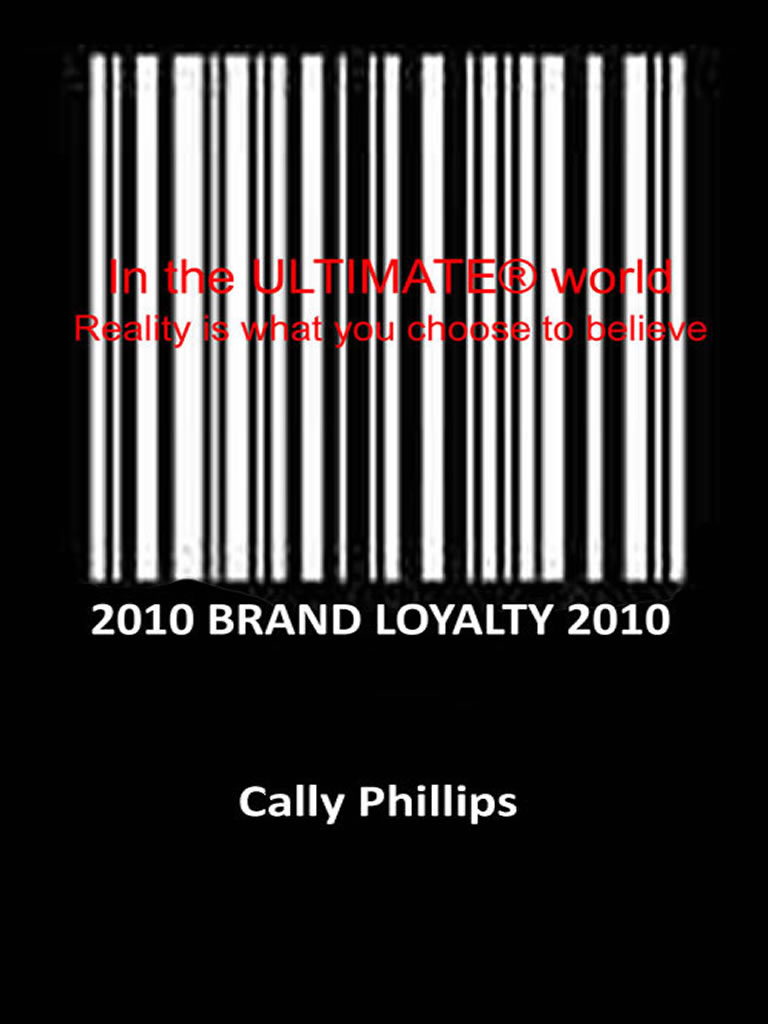
Brand Loyalty by Cally Phillips reviewed by Julia Jones

This review is posted to mark the 3rd anniversary of publication which was on 20/10/2010
Brand Loyalty sent me straight out of doors for a walk. Never mind that it was February 2011 and there was semi-thawed snow on the ground. I remember that my crutches skidded on the ice. I had to leave my computer and go outside. I needed to feel the sharpness of fresh air and experience actual, muscular movement. Walking, in the world of Cally Phillips's Brand Loyalty, is a subversive act. Consumers are most ‘productive’ when they remain passive, sitting in front of their enormous US™ screens: gaming, ordering pre-prepared, mono-branded food or, in the case of the elderly (the Victims) watching endless re-runs of packaged memories, which may, or may not, be their own. There is no longer any need to travel; holidays are a thing of the past  -- as are relationships, families, actual sex and the countryside.
This is true, especially, for the Project Kids. These selected youngsters are presented as the lucky ones. They are cocooned in the most comfortable accommodation, supplied with the largest US™ screens and earn their credits by interacting in consumer forums and playing the newest games to the highest levels. Project Kids are unlikely to want to go outside the perfect world of their compound – why should they? Everything they need has already been provided and anyway the purpose of their existence is to provide the living data that will enable ULTIMATE® always to be one step ahead in providing whatever is necessary to keep consumers passively consuming. If a Project Kid does want to go outside (thus offering alternative data for the psychological profilers to analyse) they have only to contact their counsellor and a licensed fuel efficient pod will be provided. Why walk?
Why visit a VCC (Victim of the Credit Crunch)? Why attend a birthday party? All these things are dangerous as they might encourage emotion, conversation or, worst of all, an interest in personal memory. It’s an unsettling day for Nike, Omo and Flora when they decide to visit Nike’s grandmother, Helen, who lives in a small magnolia-painted room with nothing to do except sort through the items in her Memory Bank. The danger is that Helen has lived in History.
HISTORY: Definition. A time in the past when people worried about what had happened before their own time and tried to use their worries to predict what would happen in the future. A pointless exercise.  EXAMPLE: History is bunk.
There is a black humour in Brand Loyalty,  which sometimes tips into comedy. The children have brought flowers for Helen.
‘ “They smell just like real ones,” she observed.
Nike, Omo and Flora exchanged puzzled glances.
“They are real ones, Nan,” Nike said. She’d got confused. She was old. What could you do?’
The flowers are plastic. For the children they are real because they are not virtual. They are tangible and have cost Flora half an hour’s ‘productive labour’ in a chatroom. Helen, though, has lived the best years of her life on a farm where the air is sharp and the winters cold and February a month of hibernation, tingling with the promise of spring. Her knowledge vault is ‘awesome’. Nike likes to visit her because of his secret addiction to the question Why? The question that is always about to send him overdrawn in the ULTIMATE® credit system.
Brand Loyalty is overtly and intelligently Orwellian. The relentless definitions churned out by the ubiquitous US™ may also recall the M’Choakhumchild system in Hard Timeswhere a horse became a ‘graminivorous quadruped’. The crushing of curiosity and individuality satirised by Dickens amid the surroundings of the Industrial Revolution is directly analogous to the post-Marxian processes favoured by the ULTIMATE® Corporation. Brand Loyalty is set in 2030, only twenty years after GRendHist (the Global Recession to End History) when global capitalism has succeeded in producing a homogenised, subservient population.  People have blithely up-loaded their personal data, they have acquiesced with its migration from a hard drive to a cloud and have never worried who might be profiting from this.
As I set off for my walk, invigorated by Brand Loyalty’s sparklingly cerebral mix of contemporary events, analysis and projection to the not-at-all distant future, I couldn’t help relishing the irony that I’d read the novel on a Kindle, delivered wirelessly from Amazon, an organisation directly fingered as a significant step on the road to ULTIMATE®. I might want to tweet about the experience, upload it to my social networks, tag it for the benefit of other consumer ‘communities’. Exactly like a privileged resident of the Project House. But within every organisation there’s the danger posed by the random element, the system anomaly, the Trojan Horse. That’s what Nike represents and Cally Phillips too. Her book is chilling but brilliant. I think she should look carefully over her shoulder whenever she steps outside
Reviewed by Julia Jones
Brand Loyalty is available in Kindle and epub formats. It's also available in print.
Find out more about Cally Phillips