Showing posts with label Historical fiction. Show all posts

Wednesday, 16 March 2016

Warrior King by Sue Purkiss reviewed by Karen Bush


My Dad might have kickstarted my fascination with history back when I was still a kid, but it was books that fuelled and sustained it … I gobbled my way through all the historical fiction I could find – and I’d have gleefully snatched this one off the shelves too if it had been around then. I loved reading this as an adult, and I’m pretty certain that I’d have loved it just as much back in more youthful days: it’s exactly the sort of book that I used to ransack libraries and bookshops for.

Set in the Dark Ages, it chronicles Alfred the Great’s fight to defeat the seemingly unbeatable Viking invaders and to create a united kingdom … It’s a great story - after all, what isn’t there to like, or to capture the imagination, about one of our most famous of kings, and the only one to have ‘Great’ appended to his name? And improved no end by the tale starting in Alfred’s childhood, and as it progresses, being taken up by his daughter Fleda – an equally important if often overlooked historical character in her own right.

The story will keep your attention, but there’s also a lovely sense of place too: as with all the best historical fiction, it educates at the same time as entertaining, but done with such a deft and light touch that you don’t realise it – in fact watching a documentary on Alfred and his times recently I was surprised at just how much I already knew, and due in large part to having just read this.  I’m now off to find out what else Sue Purkiss has written …

Wednesday, 6 January 2016

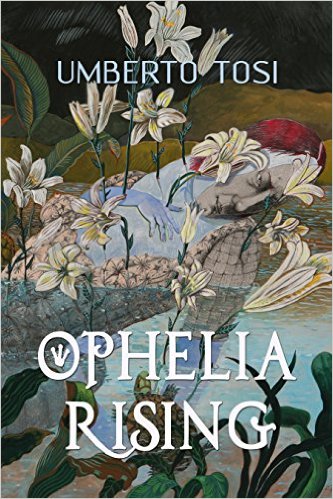
Ophelia Rising by Umberto Tosi

‘So few choices for a maiden – marriage, the madhouse, brothel, or nunnery.’ This has often been a sad truth about women’s lives, and many women – both real and fictional – have been trapped within this constricting framework. One such woman is Ophelia, the doomed heroine of Shakespeare’s Hamlet – or so you might think. In Umberto Tosi’s Ophelia Rising, she breaks free of her own fictional heritage, and becomes far more than the doomed, mad figure of the Bard’s play.

In Hamlet, as we all know, Ophelia’s story ends when she succumbs to a watery grave. Mad, broken and betrayed, she is a tragic figure. Tosi, however, picks up the narrative and turns it in an entirely new direction. In Tosi’s novel, Ophelia gets a life – and what a life it is, set against the backdrop of social and religious unrest, and involving some of the most important historical and social developments of the time. Instead of drowning, Ophelia is rescued by a group of wandering players, and joins them as they make their way across Europe – a Europe that is ravaged by war and social unrest, but which is also a place of new discoveries and developments. This is the Early Modern world, a world so unstable and conflicted that to its inhabitants it must sometimes have seemed to be teetering on the brink of collapse; yet it is also a world that is becoming more recognisably like our own.

Tosi’s Ophelia is an independent: a courageous, self-reliant and adventurous woman. Post-Hamlet, and for all the dangers she endures, Ophelia enjoys something of an individual renaissance, tasting personal autonomy and the return of precious freedom. Northern European mythology fuses with Southern European art and culture; in the course of her journey, Ophelia becomes a truly international figure. She also becomes an example of a figure that still raises some eyebrows today: a single mother, bringing up her son without any stable father figure, standing outside of the patriarchal system of the day. Indeed, far from being reliant on a man, this Ophelia sometimes becomes a man: on occasion she dresses as, and lives as, a man. She studies, writes and reads, takes an active part in the changes sweeping across Europe, and becomes part of the ongoing movement of European history. In short, this is anything but the passive, helpless Ophelia we’re traditionally acquainted with.

Tosi’s novel also reaches back into the past, teasing out the distant strands that helped to form Hamlet and Ophelia’s characters – an aspect of their intertwined stories that was left in the shadows by Shakespeare. As a child, Ophelia was a tomboy, Hamlet’s equal. She enjoyed an exhilarating degree of physical and psychological liberty, and this helped her to develop into the character she becomes. The young Ophelia is courageous, independent, and adventurous – absolutely not a passive victim, and not in thrall to powerful men.


Tosi combines beautiful prose and philosophical reflection with a satisfying pace, just as he seamlessly interweaves fact with fiction. The vastness of the setting never detracts from Ophelia, a character we come to know intimately. The result is a large-scale and yet intimate portrait of a woman, surviving as best she can in a tumultuous world. I think Shakespeare himself would be proud to see what his heroine achieves.

To download Ophelia Rising, visit amazon.com or amazon.co.uk.

Monday, 22 December 2014

The Winter Horses by Philip Kerr reviewed by Julia Jones

It’s the winter of 1941 and we are in the Ukraine. A fourteen year old girl is hiding in a wood on the vast and bitter-cold steppe. Her name is Katinka, a name from folk song and fairy tale, and she has been befriended by two of the wild Przelowski’s horses.
The name of the place is Askania-Nova, a nature reserve founded by the rich and kindly German Baron Falz-Fein. The Baron and his family have been driven out by the Bolsheviks but are still remembered with deep affection by the ancient Ukrainian curator Maxim Borisovich. Stalin’s policies have starved the countryside and Max has endured torture at the hands of the state police as well as the loss of his wife. Now he lives alone in his tiny cottage with only the giant wolfhound Taras for company.
By the winter of 1941 the Nazis have invaded Russia and Askania-Nova has been occupied by the SS. When their Commandant, Captain Grenzemann, a former Olympic horseman, sees the wild horses he concludes that they are a sub-equine species, a wandering Gypsy breed who must be completely eradicated in case they should mate with his cherished Hanoverians. They are also potentially meat and his men are hungry.
Almost everyone is hungry in this story, though Grenzemann and his men eat better than most. The Winter Horses is a marvellous blend of the historical situation of the suffering Russian countryside (Askania-Nova did and does exist) and the quasi-magical relationship that exists between Katinka and the Przelowski horses, Temüjin and Börte. They can speak to one another without words, an extension of the everyday understanding between people and animals that I found easy to accept in context, and extremely satisfying to read.
Things happen that are truly horrible – already at the beginning of the story Katinka has seen so much that she has lost the power to cry. Yet there are also unexpected moments of kindness – the old man Max and his wolf-hound Taras are unstintingly generous to Katinka and the horses – and the story insists that there are good and bad people on either side and that even the worst people have the potential to have been different. Nevertheless Katinka feels compelled to apologise to her animal companions for the appalling behaviour of most of the humans that they meet. If God lived on earth, she says, she’d go and smash his windows.
The Winter Horses is an exciting tale of adventure and (sometimes preposterous) escapes. I thoroughly enjoyed it and will be passing it on to my adult daughter as well as recommending it for teens and for those confident readers who have the emotional stability to get through the brief, carefully-written scenes of slaughter. Philip Kerr has managed something rather remarkable in siting his story in a space where history and legend can co-exist without either diminishing the truth of the other. He says it rather better than I do. And yet if today you were in the Ukraine and dared to put your ear into the wind or perhaps took a trip across the steppes and listened to the deep voices of the bison, the whoop of the cranes and the laughter of the Przewalski's horses, you might learn[...]that even if there are some parts of this story that are not exactly true, they could be, and that is more important.

I loved this novel - and if it's too late for the Christmas list, go on - treat yourself.

(This review was first published on The Bookbag website)


Sunday, 19 October 2014

'While No One Was Watching' by Debz Hobbs-Wyatt, reviewed by Ali Bacon

This is a cracker of a novel and one of the best e-books I have read this year (it’s also available in paperback).
It takes the question that has fascinated everyone in our generation ‘where were you when Kennedy was shot?’ and gives it a new twist: ‘what else might have happened at that moment, in Dallas, when everyone’s eyes were on the president’s car?’ 


In Debz Hobbs-Wyatt’s debut novel (which really is stunning), a child is abducted at that very moment when everyone’s back was turned.  The story is taken up in the present day by Gary, a divorced journalist living near Dallas, whose fourteen year-old son Ty visits only at weekends. While reporting on another crime, he runs into a black psychic, Lydia Collins, whose many family ghosts live on in her house and in her head. The plot is taught and multi-faceted. Gary and Lydia’s back stories have many things in common which are echoed in the events that begin to unroll.
In a powerful subplot, a horrific event takes place at Ty’s school so that he’s caught up in a crisis of his own.  

All of this makes for a compelling page-turner, but there's more to it than that. What lifts the book out of the ordinary (if it ever could have been there!) is the brilliant characterisation and in particular the voice of  Lydia, who for me is as authentic as anything in the The Help or The Color Purple.
I found this book original, intriguing and gripping and can recommend it without reservation. 


While No One was Watching was published by Parthian in 2013 and is available in print and e-book from Amazon.
You can read more about the author on her website.

Ali Bacon
http://alibacon.com
Twitter @AliBacon
A Kettle of Fish on Amazon UK, Amazon USA

Monday, 25 August 2014

Ellen's People by Dennis Hamley

“It’s dark now. The church clock has long struck midnight. Betty and Madge, twins and my younger sisters, went to sleep the moment I blew their candle out, but I can’t sleep and I’m wondering if I ever will again.”

Thus begins Ellen’s People, the first novel in Dennis Hamley’s Ellen Trilogy. Ellen Wilkins, a young woman living in rural England on the eve of World War I, has just witnessed a recruitment drive in her village. She has also witnessed some of the less attractive behaviour associated with such campaigns: jingoism, hatred of “the Hun”, and fury against those who openly prefer peace to war. To Ellen, this is more than a purely abstract concern: her beloved brother Jack has enlisted, and she worries about what might happen to him. “I don’t know much about wars,” Ellen admits, “except soldiers and sailors get killed and Jack might get killed with them.”

Ellen’s first-person, frequently present tense narration is deceptively simple. Hamley achieves a beautiful balancing act here: Ellen is highly intelligent and insightful, and yet her tone fits that of a country girl from a simple background who has received rather a basic education. Like many girls of her class and time, any form of Further or Higher Education is out of the question for Ellen: simple economic necessity means that she must, at a young age, go out to work as a maid for a wealthy family. The appalling drudgery of such work is not glossed over; Ellen and her fellow maids work long, gruelling hours for little pay and even less gratitude. When they act together to win a small but significant victory over their employers, we’re absolutely behind them. This small act of rebellion – which is really little more than a simple demand for respect – is also an indication that the determined, courageous Ellen will not remain a housemaid for long.

In the meantime Jack returns from the trenches – alive, but missing a leg, and carrying a world of rage and distress within. As Ellen struggles to nurse him and hold her family together, she develops a strong empathy for the injured and sick, and an interest in nursing as a profession. Eventually, she goes to London to train as a nurse, and from there to join the nursing corps on the Continent. From this point on, the war – which occasionally seemed rather distant in Britain – becomes shockingly real and immediate. There are hellish depictions of the bloody reality of trench warfare. Soldiers are brought into the hospital with destroyed limbs, burns, gaping wounds in their stomachs; many die in agony in front of Ellen’s eyes. There are times when she wonders if she can carry on. She does anyway, constantly growing in empathy and insight. In the end, Ellen transcends her own limitations, the expectations imposed by her sex and class, and becomes a truly rounded, sympathetic, experienced woman.

Ellen’s People is not only about war, but about the prejudice, tribalism, and blind patriotism that give rise to warmongering. It is about much else besides: a class and social structure that was slowly being eroded, family and social relationships, and the increasing shift of power to women as they not only entered the workplace but began to take on ever more responsibility. This is, in short, a world that is becoming more recognisably like our own. 1914 and the outbreak of World War I are, obviously, a full century in the past now, but their repercussions are still being played out today. If anyone thinks that this period of history has lost its immediacy and power to shock, try reading Ellen’s People. Ellen’s urgent, insistent voice speaks directly to us, and her experiences become our experiences too.


Ellen’s People is published by the Blank Page Press. It can be purchased from Amazon.com or Amazon.co.uk.

Saturday, 16 August 2014

Ellen’s People by Dennis Hamley

Reviewed by Chris Longmuir

Ellen’s People is a book with hidden depths. On the surface it is a simple story of one girl’s perception of the life of her family in wartime Britain.

It starts with a recruitment drive for young men to join the army in the early days of the First World War, when Ellen’s brother Jack joins the army. Through Ellen’s eyes we follow the jingoistic speeches which whip up enthusiasm for the war, and her fears for her brother. There is a sense of patriotism, a call to the colours, and war fever. But this leads to mob violence reflecting hatred for ‘The Hun’ with sympathisers being given short shrift. This sets off a series of events which become quite nasty.

However, things settle down and life goes on as normal with the impression of the war being far away. Ellen’s life follows it’s usual pattern which is the norm for women at the time. She lives at home and engages in domestic duties, although there are hints that changes are afoot for women.

Ellen goes into service against the wishes of her parents and gradually starts to become more independent. It is a gradual process although, through the passage of time, she trains to be a nurse and eventually goes to Abbeville to nurse soldiers.

The effect of the war on the villagers seems negligible at first, and there is a normality to the lives of the family. It is as if the war is a far distant thing that does not impact on them, until Jack comes home with only one leg after an amputation. But, even then, the full horrors are not apparent, and this reflects the propaganda stance the government took on the Home Front, where the realities of the conflict were not shared with the populace.

Slowly the realistion of what the war is all about dawns on Ellen, although it does not really prepare her for the full horrors she will experience when she goes to Abbeville in Belgium to nurse dying and wounded servicemen.

Ellen is an engaging character with the ability to draw the reader right into her life. The normality of that life in the beginning, and the blinkered view people had to the war, contrasts with the reality of the war’s impact. The class system at the time and the powerlessness of servants is obvious, as is the gradual shift of power to women who want to work. There are many threads to this story, but none more so than Ellen’s gradual awakening to the full horrors of what war entails.

This is a book well worth reading, and one which will draw the reader in with a firm grip, and not let go until the final paragraph.

Chris Longmuir

You can buy the book here:


Monday, 4 August 2014

Ellen's People by Dennis Hamley reviewed by Julia Jones

Ellen's People is the story of a young girl and her family struggling to survive the First World War. In August 1914 Ellen is just 16 and is living in the Sussex countryside with her parents, her older brother and two younger sisters. Her father is a signalman and has some strong 'anti-toff' views. Class suspicions, village tensions and family relationships make for an unexpected flare-up of local conflict when the recruiting officer arrives and Ellen's brother volunteers. There is, as any reader will guess, considerably worse to come.

Ellen's People is suitable for older children as well as adults. The horror and the strain of war is fully acknowledged but it is mediated through the central character, who is a loving and grieving sister rather than a combatant. There is a simplicity in the writing which is attractive and accessible and reflects Ellen's youthful personality. From a relatively sheltered position in the middle of her family she is forced out into the world and has to make her own accommodations with the mix of snobbery and kindliness that she encounters from her employers and others. Dennis Hamley is adept at conveying the social attitudes of a century ago while avoiding stereotypes. One of the pleasures of Ellen's People is the variousness of the characters, whatever their class. Their reactions are determined by their personal and moral qualities as much as by the conventions of their social position – though these are never underestimated.

I found Ellen's People a pacy, engrossing and convincing read -- though as an adult with a strong interest in history it didn't tell me anything about World War 1 that I didn't already know. But that wasn't why I was reading it.  Dennis Hamley is such an accomplished writer and develops Ellen as an engaging and honest observer as well as a quietly determined participant. I'll be glad to follow her in her postwar future though I don't suppose that her life is going to be easy as she attempts to settle back into the village. In these four traumatic years Ellen has learned too much about humanity to be comfortable with narrow class-based or nationalistic assumptions -- rather as the gallant Boer War veteran of the opening chapters had found himself dangerously out of sync with his neighbours back in the sunny days of August 1914.

Ellen's People is published as an ebook on August 4th 2014 and will soon be the first production from the newly founded Blank Page Press.
In the USA Ellen's People was published as Without Warning

Sunday, 23 March 2014

Gathering Storm by Maggie Craig


Reviewed by Chris Longmuir

Edinburgh in 1743 is a dangerous place, and Maggie Craig does not shy away from the scheming and brutality of some of its residents.

We first meet the main character, Captain Robert Catto, as he leads his town guard on a raid of Surgeons’ Hall, where they expect to find an illegal dissection in progress. I particularly liked the description of the Town Guard as “A Pack of wolves metamorphosing into men”. Captain Catto may have his sword, but the men are highlanders carrying Lochaber axes.

Captain Catto presents as a brutal man, insensitive to the fear and pain he imposes on the household of the surgeon-apothecary, in particular, the daughter of the house, Christian Rankeillor. But, as the book progresses he turns out to be a much more complex character than he initially appears.

Christian, on the other hand, comes across as a caring and intelligent woman, unusual for the time and place. But she is pulled into the Jacobite conspiracy, and as a result comes into conflict with Captain Catto.

At first, because of the opening raid on Surgeons’ Hall, I thought this was going to be a resurrectionist novel, with themes of grave-robbing and dissections. However, the main theme surfaced as a Jacobite rebellion one, with conspiracy, spies, and murder. Oh, and a little romance thrown in as well.

The historical background is well depicted, and the poverty and despair of the ordinary people is realistic enough to make the reader shudder. The abuse, rape, and murder of working class women, is of little consequence to their oppressors who are of more noble birth.

This book kept me guessing right up to the end. I could not see how the electric spark of attraction between Christian and Catto could ever be resolved given the extreme nature of their differences. And I’m not going to tell you whether it was resolved because that would be too much of a spoiler.

I enjoyed this book very much because of the historical accuracy, the political aspects, and it was a rattling good story.

Chris Longmuir

You can find the book at:-


Friday, 7 February 2014

The Founding: Cynthia Harrod Eagles, reviewed by Kathleen Jones

The Founding

by Cynthia Harrod Eagles


If you like Philippa Gregory, you'll love this. I read another writer's blog (Random Jottings - The End of a Dynasty?) recently lamenting that Cynthia Harrod Eagles' publishers had 'dropped' her because sales of her cult historical novels weren't as high as they would have liked. The blogger raved about the Morland Dynasty and the Kirov Saga (the latter set in Russia) and I was intrigued. Here was a writer with a long track record of rave-reviewed historical fiction and I'd never stumbled on her before. Why? Under-promotion, the blogger suggested - all the publisher's fault, and one of the reasons why so many writers are now self-publishing. So I hopped over to Amazon and downloaded the first of the Morland Dynasty saga - The Founding - set in the 15th century world of Richard III, Elizabeth Woodville, Margaret of Anjou and the Wars of the Roses - Lancaster and York.

I was immediately gripped by the central character - Eleanor Courtenay, impoverished ward of Lord Edmund Beaufort (grandson of John of Gaunt) - who is sold off in marriage to a wealthy Yorkshire sheep farmer and wool merchant who wants to trade his money for a bit of spit-and-polish and some aristocratic influence. The gently born and educated Eleanor is transported to a filthy northern farmhouse and bears four children in three years. Eleanor's courage and sheer bloody-mindedness win in the end, but the influential connection she brings with her also carries obligations that are not always comfortable. She and her husband find themselves caught up in the civil war and torn between allegiance to the Lancastrian Beauforts or to Richard of York. Eleanor's private loyalties prove costly.

It's been a very good read with accurate historical detail - a wonderful insight into the way women had to live - enduring superstition and prejudice and almost continual child-bearing. I also liked the way that Eleanor's character developed through the book as she aged and was changed by circumstance. I'm off now to down-load the next book, The Dark Rose, to follow the fortunes of Eleanor's grandchildren. There are 35 books altogether, bringing the family's fortunes up to the present day, so I expect to have to pick and choose a bit, but there are some readers who have read every one and are totally addicted!

I might also follow Random Jottings' suggestion and write to the the publishers to protest about their actions - it's time Readers started to make publishers aware of what they want. 

The Founding is currently available second hand for 1p, on Kindle for £4.72 and free from your local library. 


Kathleen Jones writes biography, poetry and historical fiction.  She blogs at 'A Writer's Life'. 

The Sun's Companion - 20th century historical fiction.  

Saturday, 28 September 2013

A salt-splashed cradle by Chris Longmuir

Review by Bill Kirton

Chris Longmuir’s books so far have been mysterious, suspenseful stories concerned with some of the darker depths of human nature. So it’s surprising to learn that this one (which was apparently written before the others) is a romance. But fans won’t be disappointed. Yes, it’s a romance but the murkier motives and actions are still in evidence.

It’s set in a fishing community on Scotland’s north-east coast in the 19th century and the author’s familiarity with the setting and her research into the customs and attitudes of the time give it genuine authenticity. She’s recreated a time and place in which men and women have their roles, their own moralities and a fierce strength born of living lives dependent on both the sea’s bounty and its cruelties. She writes of its rhythms, of how men and women alike respond to its voice and its demands, and of the hard lives they live beside it.

The characters are varied and complex, none more so than Belle, the dangerous woman at the narrative’s centre. This is no straightforward, old-style heroine. She has strengths, weaknesses, needs and a beguiling mixture of sexual magnetism and insecurity. She belongs to this community and yet is apart from it and, as the threads of the story weave around her, her stature grows and she learns, among other things, how to say no.


A Salt Splashed Cradle carries more than one love story, but there are also others from which love is missing. The writer’s control of her material is as sure here as it is in her dark modern novels and the characters are just as vivid. She takes you back to harder, less cushioned times, creates atmospheric settings and leaves you really caring about what happens to her people.

Saturday, 14 September 2013

The Physic Garden by Catherine Czerkawska

Review by Bill Kirton

Catherine Czerkawska happens to be a friend but she’s also a talented, dedicated, thoroughly professional author who (I think) has a good readership but who deserves an even bigger one. None of that information is relevant to my reading of and response to this book, however, because from the earliest pages I was drawn in by the character of the first person narrator, a 19th century Scottish gardener, William Lang. The author folds narrative layers together so that, through his own words as he recounts his life, we learn of his loves, his sorrows, the demands of his job and  family, and above all, the pain of one huge central betrayal. And yet, at the same time, we’re able to warm to him as an attractive, highly sympathetic character. He’s not flawless, he’s sometimes quick-tempered and gauche and his naivety about some aspects of life opens him to disappointments which might well have been avoided.

All the time, though, his voice, that of an old man recalling incidents from early boyhood, adolescence, manhood and his present as a grandfather, is consistent. It’s a tour de force on the part of the female author who disappears entirely inside her character.

The narrative seems always to be in a present, but it’s a changing one: the present of his time helping his father, who tended the physic garden at Glasgow University; his apprenticeship and eventual appointment as his father’s successor; his friendship with a young professor; the birth and growth of his love for his Jenny; the excruciating pain of the denouement; and then the quiet satisfactions of his later years. The narrative’s leisurely pace fits the subject well because his time is spent in his beloved garden or roaming the countryside looking for botanical specimens. Plants can’t be hurried and he relishes their colours, shapes and perfumes, uses his poetic gift to convey such things as honeysuckle’s ‘buttery tangle in all the hedgerows’. Indeed, the world of trees and plants informs all his thinking.

But when the authorities in their ignorance build a type foundry next to the gardens, the polluting intrusions of the ‘unnatural’ world (my word, not his) begin to stifle the plants, cover their life and beauty with a corrupting film of filth. His story thus becomes that of the shifting perspectives of the 19th century from the rural idylls of the Romantics to urbanisation, from the innocence of the natural world to the inhumanity of the industrial revolution.

But all the while that William is leading us through these experiences, he keeps reminding us of some ominous event which crushed him, destroyed his faith and trust in the world he knew so well. The mystery of this event is brilliantly handled. In the middle of some lively sequence, he’ll pause, reflect briefly on a pain he carries without explaining it at first. Then, progressively, through other ‘asides’, we learn of its source, although we still have no idea what it might be. The author even uses his granddaughter to deepen the mystery. She comes into William’s room as he’s writing so we’re suddenly faced with a different character, one leading a life clearly separated from the one he’s just been describing.

As well as the tensions and conflicts generated in William himself, there are those in the outside world. There’s the coexistence of the garden and the factory, of course, but there’s also a more subtle one in the actual seat of learning where he works. On the one hand there are studies in botany with all that implies about life and growth, but they’re directly contrasted with a subject such as anatomy, which relies on death and dissection. This, to William, is anathema and it colours his perceptions of the professors who teach the separate disciplines until, as an old man, he begins to recognise that both disciplines are necessary, a thought which sets him speculating about some of his own attitudes over the years.

The settings in which the whole story takes place are perfectly realised. Everything about the narrative reminds us that we’re with him in the 19th century. And yet, in connection with the academic theme, there are some delightful indicators of modern observations. The students get drunk and rampage through his garden, causing lots of damage, but it’s his observations on the professors and teachers that suggest some attitudes and opinions still prevail. ‘If these people were, by some miracle of transposition, to be precipitated into the real world, the world outside those venerable walls,’ he writes, ‘ I am convinced that they could never survive.’ And again, ‘Not to put too fine a point on it, many of the professors considered the students to be wholly undesirable, a necessary evil, an inconvenient interruption to the real business of scholarship.’


So, in these and other observations and especially in the character and presence of William, there’s a lot of warmth and pleasure in reading the story.  It’s a very human tale, beautifully written, written with love and yet, when two of its themes come together towards the end, the effect is devastating. It has the spareness and intensity of a classical tragedy. In short, it’s a great novel.

Monday, 9 September 2013

Veiled in Shadows, by Allan Russell

Allan Russell: Veiled in Shadows 

Historical Fiction

Reviewed by Kathleen Jones

 I’ve been following the progress of Veiled in Shadows through all its stages via the Australian author’s blog ‘Publish or Perish’, so it’s very satisfying to finally be in possession of a copy of the novel. Allan Russell chose in the end to design his own cover and have the book printed by Lightning Source, distributed through The Book Depository and Amazon.com as well as offering it as an e-book.

 Allan is a very interesting person - he has Bachelors Degrees in Anthropology and Education, but has also studied Archaeology and History.  He lives Queensland Australia with his family and is a social worker, currently working for a charity supporting the homeless. He is also a wonderful wildlife photographer - as his blog testifies - and now a published author.

World War II fiction is not my first choice, so I was a little wary. I opened Veiled in Shadows when it arrived, just for a glance over a mug of coffee; half an hour later I was still reading and my coffee had gone cold. Al is a born story-teller and I was quickly wrapped up in the characters and their lives. The ending didn’t disappoint either.

Briefly, Ebi Gausel is an ambitious young SS officer who, in 1938, meets the half English Princess Victoria Katharina von Brunnenstadt and they fall deeply in love. When war breaks out, their engagement is broken off - Ebi believes because of a misunderstanding over another woman - and Victoria is taken to England by her father. There she meets a young RAF officer, Peter Robinson, and grows to love him too. At the beginning of the war, Victoria is recruited by the English secret services and played back into Germany, involved from then on in a dangerous double game at the risk of her own life. To tell you more than that would spoil the plot. One of the other female characters, Jena, is a Polish jew who survives a massacre and is subsequently recruited by Victoria as both friend and agent. Jena was one of the characters I most cared about - feisty and vulnerable and utterly real. Even Ebi, the ‘bad guy’, has his human side, as all the Nazis did, though his deeds are graphically depicted.

Veiled in Shadows isn’t literary fiction, but it’s a very good read, and more than that it’s a book that has a moral and emotional core. The characters and their lives will be with me for a long time. Allan Russell is a very good writer. I know he’s working on his second book and I will be reading that one too!

Check out Kathleen Jones' own books at www.kathleenjones.co.uk
Kathleen blogs at http://www.kathleenjonesauthor.blogspot.com

Friday, 19 July 2013

The Threads of Time, by Cally Phillips

The Threads of Time

Cally Phillips

Pub by HoAmPresst

Reviewed by Kathleen Jones

Have you ever wondered what it would be like to wander around an archaeological dig and be physically whisked back in time?

Paul is taking part in a dig in Galloway, southern Scotland, one of the lowly muck-shifters.  But he really fancies one of the senior archaeologists - Diane - older than him, beautiful, out of his league. 

Strange things begin to happen.  Paul has dreams, but are they dreams?  And Diane begins to notice him.  Is she really interested, or is it a game she’s playing with their boss, the man in charge of the dig who has his own agenda and isn’t playing by the rules?

This is a time-slip novel with good, passionate characters and a thorough knowledge of archaeology and pre-history. As you'd expect from an experienced actor and playwright, the dialogue is excellent. It’s a little slow in parts, but apparently it was Cally Phillips’ first novel. Wonder too about this current fashion for brevity and galloping pace - perhaps we should have a new ‘slow book’ movement as in ‘slow food’?  Paragraphs of reflection and description are, perhaps, something we should give time to in our crowded lives. The Threads of Time is definitely a good read, a page-turner, and the ending is very unexpected.
I've also read Cally's Cuban novel 'Another World is Possible' - definitely worth checking out!  And I really liked her short story collection 'Voices in Ma Heid', written entirely in Scots - not easy for a sassenach to read initially, but when I got my ear in, the stories were moving and sometimes shocking.  Cally is a highly political writer and her books are a must-read if you're looking for something different.

Thursday, 18 July 2013

Review of Spirit of the Place

I have never been a fan of the eighteenth century. Literature, drama, style, politics, culture they all leave me thankful that the Romantics burst onto the scene saving us all from the worst excesses of what went before.
But in Spirit of the Place, Dennis Hamley draws me into his vision of the eighteenth century and opens my eyes to possibilities. My first favourable impression was the description of the aging Alexander Pope. Just as I imagined him to be. And immediately I realised this was not going to be a straight homage to an age I hated. It was an examination of the age from a variety of perspectives. All wrapped up in a brilliant storyline. There is not so much a tension between fiction and reality as a frisson between the two. In that respect I found it to be as exciting as Tom Stoppard’s Arcadia, one of my favourite plays, the memory of which Spirit of the Place evoked more than once – in a good way.
The language didn’t jar. I could believe in the eighteenth century parts while not feeling a jar when the story moved back and forth between past and present (well, two different pasts now I suppose!) The novel is what is these days called ‘timeslip’ and looks at happenings in 1793 and 1993 drawing links and parallels between them. I promised myself in writing this review I would not go into plot AT ALL, because I don’t want to spoil any part of it for the reader.
I can tell you that it deals with notions of man and his relative place in nature – and there are interesting parallels between 18th century neo-classicism and late 20th century genetics.  There is also a fascinating retrospective view of the emergence of the Internet which should give all contemporary readers a pause for thought and a slight shiver about how quickly things are moving.  There’s also more than a hint of the supernatural.  Nothing is what it seems and the plot (of which I refuse to speak) really does keep you engaged throughout.
I found myself slowing down my reading pace because while I was desperate to know what happened next, I didn’t want to finish the story. This to me is the mark of a truly good novel. I was so glad that the ebook ‘updated’ edition included a postscript which brought events nearly up to date! But I wished I’d read it when originally published as well. I wish it had been part of my minds library all these years.
Spirit of the Place was originally published in 1995 as what is now referred to as a Young Adult novel (where would we be without all these categorical definitions eh?) but I have to say I’d never have thought it.  I suspect it was more down to extant relationships with childrens publisher Scholastic than anything else. Why a mainstream publisher didn’t pick it up then remains a mystery as profound as those contained within the novel itself.  All I can say is when I was a Young Adult (many moons ago) there was no such category and I have to say I think it can be a dual edged sword.  In 1995 I was in my mid 30s and there’s no way I would have bought a young adult novel. But in 1995 I read and enjoyed Arcadia. I didn’t see it performed till 2005. To my mind Spirit of the Place is very much adult fiction (no, I don’t mean adult fiction xxx) in that it deals with some deep issues. Yes they are accessible but they are not issues just of interest to young adults. So I’m sorry that I never got the chance to read it back then, but I’m happy to have had the chance to read it now. It’s one of those books with images that will stay with me. That’s why I’m not telling you ANYTHING about the plot.  I want you to have the experience and go on the journey for yourself. But do go!
Available in kindle format
Find out more about Dennis Hamley

Friday, 12 July 2013

Dreams of the Blue Poppy, by Angela Locke

Dreams of the Blue Poppy

by Angela Locke

Historical Fiction -

At Bambeck Hall in the Lake District, two children are born on the same day, a boy and a girl, but their fates are supposed to be very different.  Elizabeth Richardson is the daughter of the butler, and Charles Fergusson is the son of the owner.   Betty, as she comes to be known, lives below stairs, but her flaming red hair hints at a closer Fergusson connection.  Charles, suffering from a congenital heart condition, is confined to a wheel chair, but is encouraged by his grandmother - the enigmatic Maud - to dream of the Himalayas and a rare species of blue flower which had once been given to her by a Tibetan prince.

The two young people find great happiness in each other’s company and feel curiously compatible. Only Betty knows of the blood-lines that draw them together, but even she doesn’t know the whole truth of their ancestry.

This is a story of how Victorian social values and conventions warped the lives of generations of young people and how it encouraged a culture of secrecy - there were things that simply weren’t spoken of.  But the first world war was just around the corner, ready to sweep away a hundred years of rigid convention.  Betty’s father and Colonel Fergusson fight side by side and on the battlefield one man’s blood is just as red as another’s.

It is also the story of how hopes and dreams are attainable, if only you have enough courage and a little bit of luck.  Betty is a feisty heroine who isn’t going to let anyone put her down and she is quite willing to fight Charles’ corner as well!  This isn’t a conventional ‘upstairs/downstairs’ story - the plot turns this on its head, though I can’t give too much away.

The novel is beautifully written by an author with a long pedigree in publishing.  Angela Locke began working in children’s television and is the author of the Search Dog books set in the Lake District, a children’s novel ‘Mr Mullet Owns a Cloud’,  a book on travels in Tibet, 'On Juniper Mountain',  as well as being a published poet, journalist and former editor of glossy magazines.  You know you’re in safe hands from the first paragraph.  And the book is also beautifully designed with small floral motifs framing every chapter.  Good to look at and good to read.  
 
Reviewed by Kathleen Jones

Dreams of the Blue Poppy
by Angela Locke
E-edition by The Book Mill
(Previously published in hardback by Robert Hale)