Showing posts with label nicci gerrard. Show all posts
Thursday, 30 June 2016
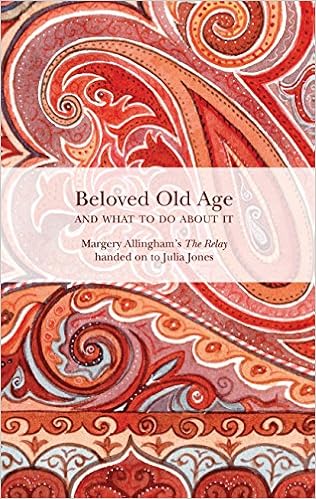
Beloved Old Age - and what to do about it, by Julia Jones and Margery Allingham (publ. Golden Duck)
This is a really unusual book which defies genre boundaries, usually a recommendation in itself. Julia Jones is the biographer of Golden Age crime queen Margery Allingham and as such, has been lucky enough to be entrusted with access to her documents. Among them was an oddity, Allingham's very last book, unpublished, and a departure from her popular murder mysteries. 'The Relay' is about ageing, the problems of ageing, and how to deal with them within the family. Julia Jones has prepared this book for publication but added an enriching layer to it, in interweaving her own account of living with her mother's dementia and the changes it dictates to their and their family's lives. How to deal with ageing - now a hot topic with greater longevity, though there were plenty of tough old birds male and female who'd survived childhood infections and went on living a long long time. Margery had a very highly developed sense of responsibility and though a highly successful novelist, she ended up supporting a useless git of a neither use nor ornament husband and various other family members and hangers-on, while writing her heart out to outrun tax demands and keep them all in the style to which they felt entitled to become accustomed. Still, she never seems to have considered ditching the old dears but ended up evolving a system to enable 'the relay' to continue. By this she means, allowing the experience, wisdom, stories and any other accumulated life material to be absorbed into the family before the old depart.
Uniquely in my experience, she writes of looking after one's own family oldies as a privilege, and a vital part of the family, not just a duty or a burden, though she acknowledges the enormous stresses involved. Poor Margery seems to have had a nasty mother who enjoyed putting her down, but even she gets taken in. So Margery and her sister set up a home for their mother, and two aunts, in a cottage over the road. Margery calls this system a 'dower house' system which nowadays makes it all sound very posh and upper class, but she was referring to an old tradition whereby the older generation live out their days in a nearby house, with support from family. What we'd now perhaps call a 'granny annex' which is patronising rather than posh, not much of an improvement vocab-wise. With great honesty, she describes how to set up such a system - it's vital to have someone professional looking after them, a housekeeper/home help, to take some of the personal stress from family. I was much struck with the points she made, back then when almost everyone had servants who wasn't one, that this person's salary should be the largest part of the expenditure by far, and they should have adequate time off covered by family members. So many people now who work caring for elderly people are on minimum wage. We have no respect for carers either family struggling alone or paid carers.
This would be interesting in itself as a book, but Julia Jones has added her own experiences and her personal responses to her own 'relay race' with her mother in journal-like entries which comment on Margery's writing too. Many many of us have had to cope with forms of dementia and other disabilities in our older loved ones. Julia writes with searing honesty of when she struggles to cope, when she loses patience, and also of the joys and humour and special moments of intimacy they share. Julia has been co-running 'John's Campaign' with Nicci Gerrard, to fight for the rights of those with dementia to have family or carers with them in hospital to preserve their identities and care for them properly. We still have a long way to run in this race, and this book is fascinating, moving, beautifully written by both Margery and Julia, and really thought-provoking. Sadly, Margery died aged just over 60, worn out, and so didn't become the dowager herself, but her writing passes on the baton of her creativity and thoughts to us now that Julia Jones has written this book and edited Margery's part of it.
I kept wanting to carry on the 'relay', reply to Julia's meditations on Margery's chapters sparked memories of how I coped with my mother's dementia and the research I did into neuroscience to write poetry about it. Perhaps the book could be blogged one day with the facilities for people to add their own wisdom and experience of being old, and being the next one down waiting for the baton. Claudia Myatt who designed the beautiful cover wrote a very moving song about Julia's mum, and so we share our voices and our experiences and express them in art.
Valerie Laws
Labels:
ageing,
carers,
caring,
Crime Fiction,
dementia,
dower house,
eBook,
family,
GoldenDuck,
john's campaign,
Julia Jones,
Kindle,
Margery Allingham,
nicci gerrard,
old age,
paperback,
relay,
The Relay,
wisdom
Saturday, 10 January 2015
Being Mortal - Atul Gawande reviewed by Julia Jones
![]() |
| Being Mortal: Illness, Medicine and What Matters in the End |
I was deep in the pre-Christmas desk-tidy when I found a slip of paper where I'd written these wise words. “I'm a children's author and I deal with good and bad and is there such a thing as innate evil.”
I'm ashamed to say that I can't remember who said or wrote this, though I can think of a whole list of likely candidates. I'm also a children's author and I've been surprised to discover how frequently I deal with death -- as well as good and bad and the springs of evil. Not just death as the convenient bumping-off of villains but the deaths of characters who, as an author, I have come to love; deaths that make me cry. This is one of the uses of fiction, enabling us to practise facing the harshest facts of life, yet still with the ability to shut the book and run outside to play.
Death is not something that most of us see very frequently in this country, whether we are children or adults. Our life expectancy is longer, our healthcare aspirations higher. Death happens, as inevitably as ever, but increasingly it's something that happens off-stage. With the recent death of right-to-die campaigner, Debbie Purdy, and the End of Life (Assistance) Bill going through the Scottish Parliament, 2015 may be a year that we collectively think more deeply about mortality and end-of-life care. Old age and vulnerability are much on my mind at the moment as I'm deeply involved in John's Campaign with my friend Nicci Gerrard who lost her father in November 2014 - or did she lose him when he spent five unsupported weeks in hospital earlier in the year?
Atul Gawande is a surgeon. He lives and works in Massachusetts, keeps in close touch with his family roots in India (where he is running a large research and teaching project) and was the BBC Radio 4 Reith lecturer in December 2014. The four Reith Lectures were titled “Why do Doctors Fail?”, “The Century of the System”, “The Problem of Hubris” and “The Idea of Well-Being”. All are available to listen to on-line or print out for free – so why did I buy a half-dozen copies of this hardback book to give family and friends for Christmas?
The answer's obvious. Being Mortal has a range and a coherence, a steady development of argument that's simply not possible in a lecture series where only individual facets of an issue can be reflected. Gawande begins with the long life and traditional old age care of his grandfather Sitaram Gawande, a farmer in a small village 300 miles inland from Mumbai, who rode round his fields every day until he died – at the age of 109. It was not that Sitaram was extraordinarily physically adept. He would have failed most of the eight “Activities of Daily Living” that an American health care professional would have used to assess his ability to live independently and he would therefore have been consigned to a nursing home. But living as the most senior member of a large extended family he was never even required to tie his own shoe laces.
Atul Gawande writes with undisguised dislike of the dreary, regimented, infantilising old people's 'Homes' that are nothing of the sort, and with respect for the foundation of the Assisted Living Movement. These are US examples of course but it's simple enough to make the connections to UK institutions. Again and again he gives examples of actual older people he knows and their struggles to find the right circumstances to enable them to live good lives into old age. He doesn't romanticise the traditional family living that served his grandfather so well. He knows that this is not possible or wanted any more, yet he is certain that there must there must be ways in which people can continue to exercise some choice over the way they live – right until the end.
As a cancer surgeon Gawande is only too aware of the part played by illness in closing down life's possibilities. It is this that troubles him most of all – too many people now die in hospital, too many extensive, painful – and ultimately unnecessary – operations are allowed to blight the last days of life. Should doctors continue to play god – deciding what can be done within the vast possibilities of modern medicine and forging ahead to do it? Should they step back and offer information about all options, however unlikely and experimental, then expect the patient to make an unaided decision? Or could the consultation be something more holistic? Gawande aspires to a role where he is able to warn someone that they are coming towards the end then ask them what they want from their final days. As a doctor he can then either go for the big operation or for something simpler and temporarily alleviating, before using the resources of the hospice system to make the last wishes happen – ideally in the person's home.
Being Mortal is an expert's reflection on life, rather than death -- making sure that life continues to be satisfying and individual for as long as it lasts. I shall certainly be reading it again in 2015.
(This review first appeared on the Awfully Big Book Review site)
Subscribe to:
Posts (Atom)

