Showing posts with label Sailing. Show all posts

Saturday, 13 June 2015

Regatta by Libby Purves reviewed by Julia Jones

May was a merry month for new books and book reviews. I had been writing for the Bookbag site (unpaid but congenial and another way to feed one's habit) and was somewhat delighted to discover that three books I'd reviewed were all being published on the same day. They were This Is Not A Love Story by Keren David, Liberty's Fire by Lydia Syson and The Golden Age of Murder by Martin Edwards. I also reviewed A War of Flowers by Jane Thynne and The Lady from Zagreb by Philip Kerr. All admirable and enjoyable and highly recommended. If there'd been a maypole handy I'd have gone skipping round it, plaiting many-coloured ribbands. Many books good: more books better. 

However, when a friend insisted that I should read Regatta by Libby Purves, my heart plummeted. I'd just completed a new sailing adventure novel and was feeling thoroughly insecure The central character is a black girl in a competitively white world -- just as in Regatta. I had wanted feedback on my story but the one thing that I definitely didn't want to hear was that it had  been “done” already – particularly by someone as good as Libby Purves. One Summer's Grace, her non-fiction account of a circumnavigation of Great Britain with her 3 and 5 year old children is a modern classic of sailing literature.

Regatta is fiction. It's set in a Suffolk coastal town named Blythney a thinly disguised version of Aldeburgh – except that the disguise is so thin that it's less than invisible. The peculiar intensification of life and relationships that takes over the Yacht Club set during the regatta month of August is so skilfully observed that it becomes almost more real than the actual. The yummy mummies and the teen drinkers, the businessmen who have swapped their suits for baggy shorts and buffoonery, the racing hearties and the competitive picnic-makers are all there – as they appear to have been from generation unto generation. Then, into this festival of class-based bonhomie, comes a thin black child with a twisted foot and a self-defensive attitude that slips quickly to aggression. I wasn't sure I was going to be able to read it.

Anansi is the unloved child of a drug-dealing mother and an absent father. Her lameness is the result of a deliberately -inflicted injury compounded by neglect. She has been sent to Blythney by a Country Holidays Organisation in order to benefit from the fresh air and organised activity. There's an 'anyone-for-tennis' moment early on when even her relentlessly jolly hostess realises the complete impossibility of Anansi joining in. The novel constantly questions the wisdom, the efficacy – even the kindness – of such summer holiday up-rootings of inner city children while simultaneously allowing full recognition of the genuinely good heart and decency of the Blythney hostess who is struggling to help. It would have been so easy for Regatta to be angry caricature all round.

Casual unkindness provokes Anansi into announcing who she has seen doing what to whom, up against the wall in the damp Martello tower. She consciously intends it as a bomb but has not realised “how long, how slow, how messy and unsatisfying a carnage she had wrought.” Regatta is a novel for adults which is about children – rather than a book for children themselves and the adult mix of shock and comedy is finely observed as the high tide squashes everyone together on the picnic beach as they fail to escape what has been said. The emotional sympathy flows towards the adulterer's two unattractive teenage sons. One blushes dull red and turns away: the other is pale and pinched, staring into space.

No-one is without fault and for most there is a measure of redemption and relief. Choices and relationships are central – as they would be in any novel but the element that made Regatta outstanding for me – even among such an abundance of reading pleasure – was the portrayal of the river. It's a major catalyst for personality development change as young Anansi learns to sail and individual Blythney children make crucial decisions whether to treat it with respect. They've been protected by safety boats, allowed to treat it as a playground and some have come close to forgetting that it remains an alien element. Human error and the harsh environment precipitate a tense and terrifying crisis with no more props needed than some soft mud, a grounded dinghy and a few strategic planks.

Harry, the old man who has been the first to notice the potential of Anansi, views the river differently. He is knowledgeable, experienced and expert but he is also alive to its beauty and spirituality. “On a morning like this, no problem was insoluble, no grief inconsolable. His eyes misted a little: beyond this view, this dawn and this river, there hung some intangible, enormous truth and illimitable goodness.”  

My eyes misted a bit at this point. I wouldn't really claim that I am reviewing Regatta. It's not a new book (though it is available on Kindle) and my copy has the melancholy rubber stamp WITHDRAWN FROM SWINDON PUBLIC LIBRARIES –  I am simply using this space to say that all the books I've read this month are good, but this, for me,  is special.

Regatta is available as a Kindle ebook

Thursday, 9 October 2014

Revisiting the Riddle of the Sands - Mark Chisnell's Fulcrum Files and Sam Llewellyn's The Shadow in the Sands

Back to the Sands....? Re-reading Erskine Childers's  The Riddle of the Sands reminded me of two thrillers which took their inspiration from that classic location. I remembered that I'd previously written brief reviews so I hoped this might be a good moment to re-post them.
The Fulcrum Files
This review of Mark Chisnell's The Fulcrum Files first appeared in the Indie Ebook Review in July 2012
The Fulcrum Files makes excellent fictional use of a little known piece of historical fact. It is set in 1936 around the date that Hitler re-occupied the Rhineland and before the Munich Olympics. In Camper and Nicholson’s boat-building yard no one is thinking of European politics: their efforts are focussed on the final stages in the construction of a magnificent J-class racing yacht with a revolutionary new mast, ready to be rigged. It’s a tense, technical job, the yard are under pressure. And then there is an accident.
Or was it murder? This is a terrific beginning to a thriller and will have fans of the earlier Sam Llewellyn novels rejoicing that their time has come again. But how does it connect to pre-WW2 politics? I don’t think I’m giving anything away if I mention that the immensely wealthy owner of the new yacht, the man who is fixated on getting her ready for the next Americas Cup race, is obviously based on Sir T.O.M. Sopwith who was commissioning J-class yachts from Camper and Nicholson’s at that time.  In an author’s note at the end of the book Mark Chisnell mentions a trip made by Sopwith’s representative, Frank Murdoch, to the M.A.N. factory in Augsburg in February 1936, in connection with the diesel engines for Sopwith’s new motor yacht. Murdoch was astounded by the extent of military preparation that he observed on this visit. The report he made on his return prompted Sopwith to order an early start to the production of Hurricane fighter planes. And the rest is history …
I love stories that play so neatly between fact and fiction. I also relish novels that give a respectful twist to their classic predecessors. Chisnell makes skilful use of the granddaddy of all invasion novels, Erskine Childers’s 1903 Riddle of the Sands. A thrilling chase through the sandbanks of the fog-bound Frisian Islands forms the climax of The Fulcrum Files and manages beautifully to echo Childers while transposing the action into quite different vessels.
You don’t have to be a sailing enthusiast to enjoy The Fulcrum Files – in fact my only gripe was that we didn’t get to sea quite often enough. This is a well-researched historical thriller with romantic extras. The hero is a poor boy with a brain and the complex snobberies he encounters are sharply delineated. Two nicely contrasted heroines, lots of period detail and a touch of industrial strife thrown in. This is a big book, well-worth settling down to.
The Shadow in the Sands Sam Llewellyn's The Shadow in the Sands has only recently been made available on Kindle. It's just as entertaining as The Fulcrum Files and I wish I'd written about it in greater depth. All I actually managed, a year or so ago, was a few hasty sentences on Amazon:
"I really enjoyed The Shadow in the Sands. The link to The Riddle of the Sands is cleverly managed but the tone is quite different. Shadow of the Sands is an entertaining fast-paced thriller which perhaps suffers if readers try to take it too seriously. I always relish the chippy social attitudes of Sam Llewellyn's characters but what made this novel SO good was the detail of the sailing and the real adventures of anchoring, getting stranded, navigating through this extraordinarily treacherous archipelago. I almost thought that the worst crime in this story was when the villains cut the withies..."
Julia Jones

Friday, 25 July 2014

Go Green by Claudia Myatt reviewed by Julia Jones


Go Green! is published by the Royal Yachting Association as part of a series of instructional books by the illustrator / sailor Claudia Myatt . The series began with Go Sailing! an introduction to dinghy sailing that has been a world wide success and is as wonderfully clear for adult beginners as it is for the children who are its primary audience. Then came Go Cruising! Go Inland! Go Windsurfing! + various associated activity books. 

Go Green! is the odd one out in this energetic company.  It's a plea for the Blue Planet: an environmental book which will be accessible to the youngest readers and yet includes memorable facts and clear explanations that will do no harm at all to older members of the family. I believe it should find a space in all primary school libraries and holidaymakers off for their annual seaside jolly or luxury cruise should make sure they pack a copy. In fact, if Go Green!'s message is fully taken on board (pun intentional) a copy should be placed beside every lavatory in the land.

“What do the oceans do for us?” asks Go Green! – “and what do we need to do for the oceans?” It begins at the beginning with the earth as a hot waterless lump of rock covered by a cloud of dust and gases and ultimately, I suppose, its mission is to stop us returning to some similar state. I've never been good with geology so I felt clarified rather than patronised when I looked at a drawing of those early continents, Panthalassa and Pangea, and read Myatt's description of the land as being “like bits of toast floating on a bowl of thick molten rock soup”. Did you know that America and Europe are still drifting apart at the rate of 2cm per year? I didn't.

The scientific basis for Go Green! comes from Dr Susie Tomson who was inspired to become an environmentalist by the seaside holidays of her childhood. The lively drawings, bad jokes and memorably clear explanations are all Claudia Myatt's. They make the book palatable and pleasureable without diluting the main message. A cheery heading such as “Twinkle, Twinkle Little Squid”, for instance, helps a word like bioluminescnce to trip off the tongue with no trouble at all. Go Green! is a little like the Horrible Geography series but it's accessible to a far younger age group. My five-year-old grandchildren have been composing letters to Greenpeace in school this term. Go Green! could have been written for them – while at the same time offering me the chance to field such innocently tricky questions such as “why does seawater taste salty?”

Claudia Myatt is the daughter of a meteorologist. Her colourful diagrams of trade winds and ocean currents leads convincingly into an understanding of the Great Pacific Garbage patch which in 2010 "was thought to be almost as big as Western Europe.” Plastic is the major villain of Go Green!   “Bodies of dead sea birds are found full of plastic, baby birds are fed pieces of plastic by their parents and then die of starvation.” 

Glass and some types of plastic may take as long as 500 years to degrade but there's nothing reassuring about this. The long process begins as soon as the plastic finds its way into the sea “until it becomes tiny particles suspended in the water – a kind of plastic chemical soup. It's now possible that there is more plastic in the sea than plankton. Some of that chemical soup ends up inside fish of course and gets into the food chain. And guess who eats some of that fish? That's right – you and me.”

The obvious temptation is to blame sailors for polluting the oceans. Go Green! is firm about the Marine Code of Conduct that sailing children should make their parents follow.  “We do not throw anything overboard” is Number One. However the vast majority of the rubbish in the sea has arrived there from the land. Don't throw it away, says Go Green! Reduce, reuse, recycle. Even landfill is better than allowing litter to reach the sea. THERE IS NO SUCH PLACE AS 'AWAY'.

Go Green! is a crusading book but it also including some charming pages of birds and shells and other “beach treasures”. Myatt wants children to waggle their toes in rockpools or blag their way onto square-rigged ships. She also wants them (and us) to treat the watery world with care and respect. The final fact I'll take away from Go Green! is that there is NO NEW WATER. It changes its form – vapour, liquid, solid – and may also change its distribution pattern but the total quantity remains the same. 97% of (liquid) water is in the sea. Round-the-world racer Mike Golding endorses Go Green's message "We need to learn to understand how to change our behaviour on-shore, thousands of miles away, to keep the oceans safe and clean up the planet. This, truly, is a book "for gulls and buoys everywhere".


(This review has previously appeared on the Awfully Big Blog Adventure Review site.)
Claudia Myatt is also the illustrator for the Strong Winds series among many other artistic and maritime activities. You can read more about her via her website www.claudiamyatt.co.uk

Sunday, 10 November 2013

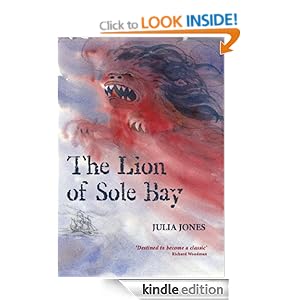
The Lion of Sole Bay by Julia Jones

Reviewed by Chris Longmuir
The Lion of Sole Bay (Strong Winds) 
Although this book was out of my comfort zone, I read it because I knew Julia Jones was a good writer, and I was in the mood for something different. What I didn’t expect when I started reading was how much I would enjoy the story, and the strength of feeling I would have for the characters.

It was obvious after I started reading that this book was crafted by an expert story teller. The suspense and pacing ensured interest in the overall story was maintained, and the characterisation was flawless. These were characters I could believe in.

Luke, a twelve year old boy left to fend for himself on his father’s boat after his dad had an accident, displayed a nice mix of confidence and helplessness in his ability to care for himself. His Dutch neighbours were weird enough to set pulses racing. Ants/Angel with her frenzied activity gave a realistic portrayal of ADHD, and despite getting up everyone’s noses, I really liked Angel. I thought she was feisty and unusual. Old Peter, who lived in the gamekeepers hut and wore a scraggy fur coat most of the time, evidently had some mental issues. The first time Luke saw him he thought the old man was a werewolf.

The menacing aspect of the book originated with Luke’s Dutch neighbours. Hendrike, a drug using mother who was lapsing into insanity. Elsevier, her partner, who provided the drugs and was using Hendrike for her own purposes. And Helen, Hendrike’s daughter. Disliking and fearing Hendrike and Elsevier wasn’t difficult to do. But I went through phases of liking and disliking Helen, who sometimes seemed as evil as the others, and at other times indicated a more caring nature. I think by the end of the book I felt more sorry for her than anything else.

The suspense was maintained throughout the book. There was always a feeling that something awful was about to happen, and when it did the suspense ratchetted even higher.

I don’t want to include any spoilers so I won’t describe the plot in detail, but the final chapters with Luke, Ants, and her father, prisoners on board a dilapidated barge in the middle of stormy seas in the English Channel was nail-bitingly exciting, and I couldn’t turn the pages fast enough.

This is a book that will not only appeal to children, and young adults, but also those readers of more mature years. I loved it.


 Chris Longmuir

Buy the book here:

Friday, 18 October 2013

Review of The Lion of Sole Bay by Julia Jones


In ‘The Strong Winds’ Trilogy, Julia Jones pulls off something quite remarkable.  To suggest it was conceived as an ‘homage’ to Arthur Ransome perhaps does both authors a disservice, because what Jones achieves in her trilogy of children’s books; in which the key features of Ransome also appear – sailing, adventure and the resourcefulness of youth in the face of an alien adult world – is something which will appeal to Ransome fans, but also to those for whom Ransome’s style and characterisation is locked in a bygone age. The ‘Strong Winds’ Trilogy is Ransome for our times. Julia Jones gives us 21st century children facing modern, everyday, real problems. Whether you like Ransome or not, you can enjoy ‘Strong Winds.’  These are contemporary stories, with ‘issues’ but without being ‘issue based.’ More than that, the adventures are founded in the reality of the lives of these very ‘real’ characters.

I thoroughly enjoyed all three books of ‘The Strong Winds’ Trilogy and could recommend them to both adults and young people alike. These are the sort of books you revel in reading for yourself and make the perfect present for other people. They are books that will sit on many a shelf for a lifetime. The only criticism I could have of ‘The Strong Winds’ Trilogy, is that, like all good things, they had to come to an end.
With ‘The Lion of Sole Bay’, Julia Jones has opened the sea chest again. Moving beyond the Trilogy ‘Strong Winds’ is destined to become a series – and I for one hope that Jone will find the time and energy to match Ransome’s Swallows and Amazons series by writing (at least) twelve novels. 

You can read ‘The Lion of Sole Bay’ as a standalone, and if you do so, you’ll rush back to read the Trilogy. If you have read the Trilogy in advance you’ll find in ‘The Lion of Sole Bay’ an author in full stride, completely comfortable with her writing style. This is a tour de force.  Certainly I have grown into the Jones style of storytelling over the past three novels and this time I sat down with some expectations, which were not disappointed.  Jones managed to far exceed my already high expectations. She has taken a ‘minor’ character from the Trilogy, Luke, to be the ‘hero’ of this tale.  In doing so she reminds us that there are no ‘minor’ characters, that everyone has a story.  Jones’ ability to present the world through the eyes of a twelve year old is impressive, and we get lost in Luke’s ‘imagination’ to the point that we start to ‘believe’ as he does. 

‘The Lion of Sole Bay’ has two ‘heroines’, both unlikely – Angel has ADHD and Helen is being reared by a seriously demented mother. The result is the sense of a ‘community’ story, with characters’ lives interwoven and the reader feels every bit a part of the story.  Jones is, as ever, uncompromising in her portrayal of such ‘issues’ as drugs and disability, but the issues are so embedded into the narrative that they never jar or threaten the storyline. They simply make the characters more real because they have the ‘real’ flaws of ‘real’ people.  This requires expertise and sensitivity on the part of an author, and Jones never skips a beat.  I am particularly impressed by the way Jones draws adult characters such as ‘mad’ Peter, and Helen’s drug-fuelled mother Hendrike. While these are shown in a way that helps a child to make sense of them, they are also convincing enough portrayals for adults to stop and think about the relationship between adults and children. We see the child’s perspective and it makes us consider our own responsibilities.  Julia Jones draws both adults and children into her narrative web, and all can learn from the story.

As for the sailing, I leave it to those more knowledgeable than myself to debate the in’s and out’s of that aspect.  Given Jones’ knowledge and love of sailing I’m sure it’s all accurate and ‘ship shape.’ For an ‘armchair’ sailor like myself, I’ll simply say it’s all thrilling enough and interesting enough to form the basis of the story.  But there’s much more to it than sailing.
Structurally the plot moves along with perfect pacing. I found myself slowing down as I read to the end, not wanting the story to end, but desperate to know what happens next. That, for me, is the sign of a truly well written novel. Using a truncated time frame, round Halloween, worked really well on a number of levels and the linking of historical ‘fact’ with the present is an element I enjoyed immensely.

The central story is further enhanced by the opportunity for the reader to ‘engage’ even more.  The ‘Sole Bay Lectures’, delivered to the children by Angel’s father in their entirety (offstage so to speak) during a particularly tense time in the story, are written out at the end for anyone who wants to know more about the original Battle of Sole Bay 1672 which forms an historical backdrop (and in some senses a metaphorical parallel) of the modern ‘adventure’ part of the story.  We are left questioning the ‘fictionality’ of M.V.Vandervelde which is a writer’s conceit I particularly enjoy.

 I get the feeling Jones enjoys writing her fiction as much as I enjoy reading it, and feeling that bond between writer and reader engagement is rare and powerful.   Julia ‘gives’ throughout the novel is so many ways.  She also gives us additional ‘material’  in the form of personal snippets such as reference to Ransome’s Picts and the Martyrs, and The Lady of Stavoren.  None of this reads like ‘research’ but all of it adds an extra dimension to the ‘story.’ As does the ‘Tales from the Wheelhouse’ section at the end where Jones explains her personal connection to the Red Lion.  Add to this a glossary of Dutch words, maps, pictures of the ‘craft’ and a set of wonderfully evocative illustrations by Claudia Myatt, and you are getting an absolute gem for your money.

I have a sense of sadness whenever I finish a Jones novel, knowing I’m going to have to wait a while for the next. But now, with four ‘Strong Winds’ to read again and twelve Ransome to keep me company till the next one comes out, I may just survive until number five hits the shelves? Next year please Julia!


Review by Cally Phillips